


A Star with a Secret
For decades, astronomers have been puzzled by a few strange things about our Sun. Standard models of how stars evolve just can't quite explain some of its features. For instance, the Sun’s surface has a surprisingly low amount of lithium, an element that
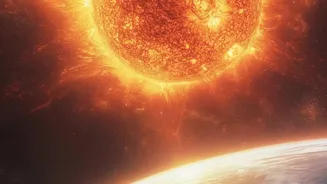
should be more abundant. Furthermore, the way sound waves travel through its interior doesn't perfectly match what theories predict. These subtle but persistent discrepancies have led scientists to wonder if they were missing a key event from the Sun's early life. Now, a new hypothesis provides a startling potential explanation: our star might be a cosmic cannibal that swallowed one of its own planets.
The Missing Piece: What is a Super-Earth?
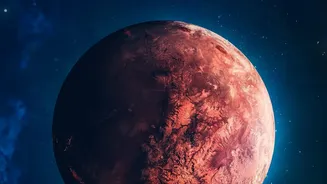
The victim in this cosmic crime scene would have been a “super-Earth.” This is a class of planet we don't have in our solar system, but which appears to be common elsewhere in the galaxy. A super-Earth is a rocky world more massive than our own planet but lighter than ice giants like Neptune—typically up to ten times the mass of Earth. The fact that our solar system lacks a super-Earth, while many others have them, has been a long-standing astronomical question. The theory that the Sun consumed one provides a neat, if violent, solution to two puzzles at once: the Sun’s weird chemistry and our system's missing planetary class.
The Chemical Fingerprints
The core of the evidence comes down to computer modeling. A team led by Professor Mutlu Yildiz of Ege University in Turkey ran simulations of the Sun's evolution. They found that if a super-Earth with a mass five to ten times that of our planet had spiraled into the young Sun, it could resolve many of the inconsistencies. Such a planet, being made of different materials than the Sun, would have left a lasting “chemical imprint” deep inside the star. The models suggest this event would alter the Sun's internal structure and explain the mysteriously depleted lithium levels on its surface, aligning theoretical models with real-world observations.
Building the Case: The Planet-Eating Hypothesis
According to the simulations, a rocky super-Earth would have been sturdy enough to punch through the Sun's outer layers without completely disintegrating. This would allow its heavier elements to sink deep into the star's interior, altering its composition in a way that could survive for billions of years. This isn't just speculation; scientists can probe the Sun’s interior using a technique called helioseismology, which studies the sound waves that ripple through the star. The theory predicts specific structural changes beneath the Sun's convection zone—a kind of scar from the ancient collision. Future, more precise helioseismic measurements could potentially detect this signature, providing concrete proof.
What This Means for Our Solar System
While the idea is compelling, researchers are careful to note that this is still a hypothesis based on modeling, not a proven fact. Other explanations for the Sun's anomalies might still be possible. However, the planet-eating theory is powerful because it elegantly solves multiple problems with a single event. It also helps us understand why our solar system looks the way it does. The early solar system was a chaotic place, and it’s very possible that planets formed and were then destroyed or ejected. If confirmed, this research would not only rewrite the early history of our own celestial neighborhood but also show that stars can hold the evidence of the worlds they destroy for billions of years, offering a new way to study the evolution of planetary systems across the universe.