








A New Weapon in an Old War
For decades, humanity has relied on antibiotics to fight bacterial infections. But over time, many bacteria have evolved to resist these drugs, creating a slow-burning global health crisis. Scientists have been searching for alternatives, and one of the most
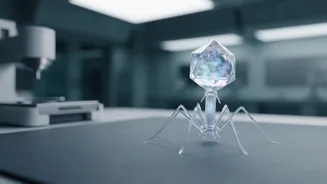
promising is phage therapy. Phages, short for bacteriophages, are viruses that specifically infect and kill bacteria. They are the most abundant life form on Earth, and each one is a natural predator to a specific type of bacteria. The idea is simple: find the right phage to destroy a harmful infection. The problem has always been that this process is slow and difficult. Finding the perfect naturally occurring phage for a specific infection is like searching for a single key in a vast, microscopic forest.
From Discovery to Intelligent Design
Instead of just searching for phages, what if we could design them? That’s the question a team of researchers at Stanford University set out to answer using artificial intelligence. This marks a significant shift from discovery-based science to generative biology. Traditionally, scientists would have to screen thousands of natural phages to find a match. The new approach involves teaching an AI model what a phage genome looks like and then asking it to generate brand new, functional versions. This moves the process from a game of chance to an act of creation, with the potential to create phages specifically tailored to defeat even the most stubborn bacteria.
The AI That Learned to Write Life
The Stanford team used a powerful generative AI model, named Evo, which acts like a language model for genetics. Instead of being trained on books and articles, it was trained on the genetic sequences of over two million known bacteriophages. By learning the complex 'rules' of viral DNA, the AI was able to write entire, novel genomes from end to end. The researchers gave the AI a starting point—the well-studied phage ΦX174, which infects E. coli—and tasked it with generating thousands of new options. This wasn't just about changing a few genes; the AI composed complete genetic blueprints for viruses that have never existed in nature.
From Digital Code to Working Viruses
An AI design is one thing, but a living virus is another. The critical step was to see if these digital creations could come to life. The researchers selected nearly 300 of the most promising AI-generated genomes for lab testing. They chemically synthesized the DNA and introduced it into bacteria, effectively booting up the genetic code. The results were astounding: 16 of the designs resulted in viable, functional phages that could successfully infect and kill E. coli bacteria. In a crucial test, a 'cocktail' of these AI-designed phages was able to overcome E. coli strains that had developed resistance to the original, natural phage. This proved that the AI could not only create life, but create life capable of solving a real-world problem.
A New Chapter for Biology
This achievement is more than just a potential new path for antibiotic alternatives. It serves as a powerful proof of concept for the entire field of AI-assisted biological design. For the first time, scientists have demonstrated that an AI can generate a complete, functional genome of a living organism from scratch. While this experiment was deliberately contained to a well-understood and non-dangerous virus-bacteria system, the implications are vast. This technology could one day be used to design everything from new vaccines and therapeutic enzymes to engineered microbes for industrial applications. It opens a new frontier where scientists can design biological systems with specific functions in mind. However, this power also brings significant responsibility, prompting urgent conversations about biosecurity and the governance needed to steer this technology safely.