


An Intriguing Cosmic Scene
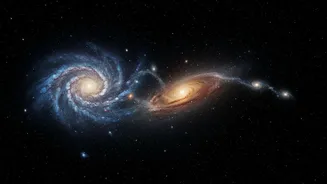
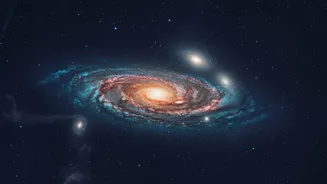
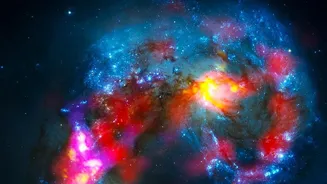
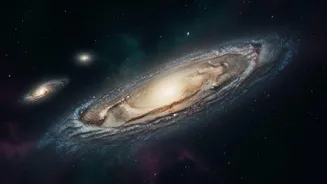
The subject of this captivating image is a trio of galaxies collectively known as NGC 7764A. Captured by the Hubble Space Telescope’s powerful Advanced Camera for Surveys and Wide Field Camera 3, the picture presents a striking arrangement in the Phoenix
constellation, approximately 425 million light-years from Earth. In the upper right, two galaxies appear to be interacting, their shapes distorted with long trails of gas and stars that suggest a high-speed encounter. To the lower left, a third, seemingly spherical galaxy looks like a bowling ball that has just crashed through the pair, creating the apparent chaos. The visual narrative is compelling, but the reality of cosmic distances tells a very different story.
A Trick of Perspective
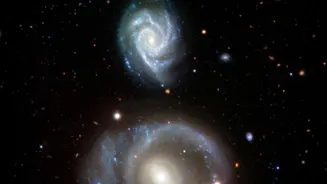
The perceived interaction between these galaxies is a cosmic trick of the light, a phenomenon known as a chance alignment. Much like how two distant mountains can appear to be right next to each other from a specific viewpoint, these galaxies are not necessarily close neighbours at all. The universe is three-dimensional, but our view from Earth is a two-dimensional projection. This means objects at vastly different distances can appear to overlap or interact. While it is unclear if the third galaxy is truly interacting with the other two, their apparent closeness in the image is not conclusive proof. True galactic collisions and mergers are incredibly slow processes, unfolding over hundreds of millions of years, not in a single, dramatic instant. So, while the visual suggests a trio locked in battle, the truth lies in their individual distances from us.
Unraveling the Real Distances
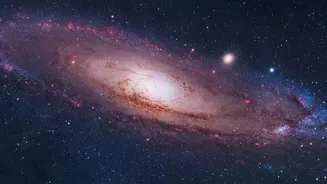
The entire group, designated NGC 7764A, is located about 425 million light-years away. The three main components are individually named NGC 7764A1, NGC 7764A2, and NGC 7764A3. While they share a collective name and appear clustered, this doesn't guarantee they are a physically bound system. Astronomers must measure the redshift and motion of each galaxy to determine their true proximity and whether their gravity is affecting one another. In many such visual pairings, the galaxies are separated by tens of millions of light-years. For context, the nearest large galaxy to our own Milky Way, Andromeda, is about 2.5 million light-years away. The galaxies in the Hubble image might be part of the same larger cluster, but the 'collision' we see is likely a matter of our line of sight.
Why These Alignments Are Useful
Beyond being beautiful cosmic curiosities, chance alignments serve a valuable scientific purpose. When one galaxy is positioned in front of another, the foreground galaxy's dust lanes can be seen in silhouette against the light of the background galaxy. This backlighting helps astronomers map the distribution of dust in the spiral arms of the closer galaxy with remarkable clarity. Furthermore, these alignments are perfect natural laboratories for studying a phenomenon called gravitational microlensing. This occurs when stars in the foreground galaxy cause tiny, temporary brightenings in the light from stars in the one behind it, allowing for unique measurements and discoveries that would otherwise be impossible. These chance alignments, therefore, turn a trick of perspective into a powerful tool for understanding the universe.