






A Landmark Study from Ahmedabad
Scientists from the Physical Research Laboratory (PRL) in Ahmedabad have unveiled a detailed picture of the Martian climate. Their study, published in the journal Current Science, provides a comprehensive map of the planet's surface temperatures and the atmospheric
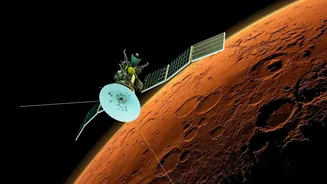
patterns that drive them. By analyzing data from the Emirates Mars Mission's Hope spacecraft, the team focused on two massive impact basins, Hellas and Argyre, to understand the planet's thermal behavior. The findings reveal just how extreme the Red Planet's environment can be, with temperatures fluctuating dramatically from a relatively mild 27°C in the summer to a bone-chilling -123°C in the winter. This work not only enhances our knowledge of Mars but also showcases India's growing prowess in planetary science.
Decoding the Zonal Waves
One of the most fascinating aspects of the study is its focus on what are known as "zonal waves." These are massive, planet-circling ripples in the atmosphere that are influenced by temperature differences and the planet's topography. Think of them like ripples on a pond; they offer an indirect window into the complex circulation happening in Mars's thin atmosphere. The PRL scientists noted a striking contrast between the two basins they studied. The Argyre basin was dominated by a large, single wave pattern (wave-1), while the much deeper Hellas basin showed more complex wave-2 and wave-3 patterns that changed with the seasons. This suggests that the immense depth and unique geography of these Martian features play a crucial role in shaping the planet's weather systems.
The Challenge of a Thin Atmosphere
So, why do these massive temperature swings happen? It's largely due to Mars's incredibly thin atmosphere, which is about 100 times less dense than Earth's. This tenuous blanket of gas is not effective at trapping or distributing heat. As a result, the Martian surface heats up rapidly when exposed to sunlight and cools down just as quickly when the sun sets. Mars's orbit also plays a part. The planet's path around the Sun is more elliptical than Earth's, and it reaches its closest point during the southern hemisphere's summer. This makes southern summers on Mars particularly intense, with temperatures soaring significantly higher than in the north. The Indian scientists' research helps to quantify these effects with greater precision than ever before.
Refining Our Climate Models
A key part of the research involved comparing the real-world observations with the predictions from the established Mars Climate Database, a sophisticated computer model of the planet's environment. While the model successfully reproduced the general patterns observed by the Hope spacecraft, it was consistently about 10 Kelvin (10°C) cooler than the actual measurements. This discrepancy is significant. It shows that while our models are good, there are still physical processes on Mars that we don't fully understand. The detailed data provided by the PRL team will be invaluable for refining these climate models, leading to more accurate predictions about Martian weather and atmospheric dynamics in the future.
Paving the Way for Future Missions
This research is not just an academic exercise; it has critical practical implications for the future of Mars exploration. As humanity plans for more advanced robotic and eventually crewed missions to the Red Planet, a precise understanding of its climate is essential for survival and success. Knowing the extreme temperature changes, wind patterns, and atmospheric behavior is vital for selecting safe landing sites, designing durable habitats, and planning surface operations. The work done by the scientists at the Physical Research Laboratory provides a foundational piece of this puzzle, helping to ensure that future explorers—both human and robotic—are prepared for the harsh realities of the Martian environment. This study marks another significant contribution by India to the global quest to unravel the mysteries of Mars.