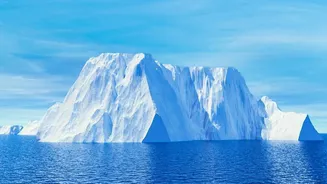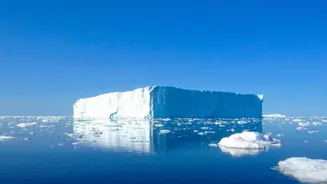








Putting 11 Trillion Tonnes in Perspective
It can be difficult to visualise a number as vast as 11.3 trillion tonnes. To put it in context, this volume of lost ice is enough to submerge the entire continental United States in roughly 1.5 metres of water. The comprehensive study, which brings together
data from 42 separate satellite surveys and 27 missions, provides the most complete picture of polar ice loss over the last half-century. This monumental loss has directly contributed to a global average sea-level rise of 3.1 centimetres, or about 1.2 inches. While that might not sound like much, every centimetre of rise puts millions more people in coastal communities at risk of flooding and erosion. For a country like India, with over 7,500 kilometres of coastline and densely populated cities like Mumbai, Chennai, and Kolkata, this is not a distant threat but an emerging reality.
The Real Story: How the Ice Is Being Lost
Perhaps the most critical finding from the study is not just the amount of ice lost, but how it is disappearing. For years, the popular understanding focused on surface melting, with images of rivers forming on top of glaciers. While surface melt is a factor, this new research reveals it's only a small part of the story. A stunning 84% of the total ice loss is due to what scientists call 'ice dynamics'. This refers to the acceleration of glaciers, which are essentially rivers of ice, as they flow faster and dump enormous quantities of ice directly into the warming ocean. This process is driven by warmer ocean waters melting the underside of glaciers and weakening the floating ice shelves that act as a natural brake, holding back the inland ice. Once that resistance is gone, the glaciers accelerate their march to the sea.
A Tale of Two Ice Sheets
While both polar regions are losing ice at an alarming rate, they are doing so differently. Greenland has been the bigger contributor to sea-level rise, accounting for about 1.8 centimetres of the total 3.1 cm increase. Its ice loss began accelerating dramatically in the 1990s and has been largely driven by both increased surface melting during hotter summers and faster glacier flow. Antarctica, a continent far larger and colder, lost about 4,780 billion metric tons, contributing 1.3 centimetres to sea levels. Its net loss has been attributed almost entirely to these dynamic changes, as warmer ocean currents eat away at the edges of the massive West Antarctic Ice Sheet. The acceleration in both regions has been stark; annual losses from Antarctica jumped from 48 billion tonnes in the 1980s to 202 billion tonnes in the 2010s.
Changing Our Planet Itself
The consequences of this epic melt extend beyond just the coastlines. The sheer weight of 11.3 trillion tonnes of ice is so immense that its removal is causing the Earth's crust to physically move. As the massive weight is lifted, the land underneath the ice sheets is slowly rebounding upwards, a phenomenon known as glacial isostatic adjustment. This shift is not just vertical; it also causes horizontal movements in the crust that can be detected thousands of kilometres away. Furthermore, the influx of colossal amounts of cold, fresh water into the oceans has the potential to disrupt major ocean currents, which play a crucial role in regulating global weather patterns. Earth is an interconnected system, and a change of this magnitude in one part has ripple effects across the entire globe.