




Meet the New Cosmic Neighbour
In a stellar system that astronomers already know and love, a new world has been unveiled. The planet was found orbiting Beta Pictoris, a young star located approximately 63 light-years away. This isn't just any star system; it's one of the most studied
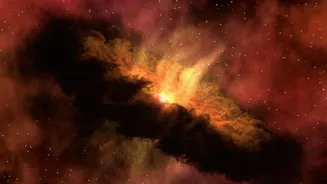
in our galaxy, famous for its swirling disk of dust and debris, a veritable nursery for planet formation. Astronomers had already confirmed two giant planets, Beta Pictoris b and c, in this system. The new discovery, dubbed Beta Pictoris d, now makes this one of the very few systems where three planets have been directly identified. This gas giant is a significant find, adding a new member to a dynamic and closely watched celestial family.
A Groundbreaking Discovery Method
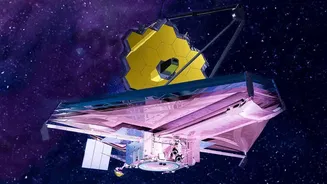
What makes this discovery particularly exciting isn't just the 'what,' but the 'how'. Traditionally, giant planets at this distance are found through direct imaging, where powerful telescopes use a special shield called a coronagraph to block the overwhelming glare of the host star, revealing the faint light of the planet itself. While JWST has these capabilities, Beta Pictoris d was found using an entirely different and revolutionary technique. Scientists detected the planet not as a point of light, but by identifying the unique chemical fingerprint of its atmosphere hiding within the system's bright, complex environment. By analyzing the light with Webb’s Near-Infrared Spectrograph (NIRSpec), they found tell-tale signs of molecules that could only belong to a massive planet.
What Is This New World Like?
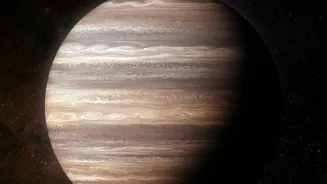
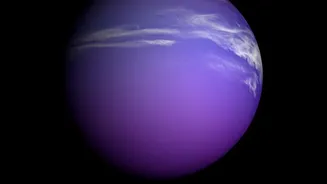
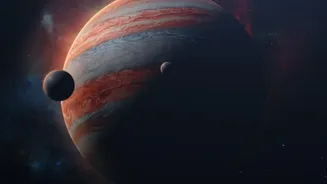
While observations are ongoing, the initial data paints a fascinating picture. Beta Pictoris d is a gas giant, meaning it's a massive world composed primarily of hydrogen and helium, more like Jupiter or Saturn than Earth. Its atmosphere appears to contain signatures of carbon monoxide and water vapor. The Beta Pictoris system is very young in cosmic terms, only about 23 million years old. Planets within such young systems are still glowing hot from their formation, which makes them brighter in the infrared light that the James Webb telescope is designed to see. Studying a planet in its infancy gives scientists a rare opportunity to watch planetary evolution in action, offering clues about the forces that shaped our own solar system billions of years ago.
A Window into How Planets Form
Every new exoplanet is a piece of a grand puzzle, helping us understand how planetary systems come to be. The Beta Pictoris system, with its three giant planets and massive debris disk, is a perfect natural laboratory. By studying the orbits and compositions of Beta Pictoris b, c, and now d, scientists can test theories of planet formation. Did these giants form far out and migrate inward? Did they form in their current locations? The discovery of a third planet provides crucial new data points to refine these models. The novel detection method also proves that planets can be found even when they are hidden by the complex light of surrounding dust and gas, opening up countless other star systems for a new kind of search.
The Beginning of a New Chapter
The discovery of Beta Pictoris d is more than just another tally mark in the growing catalogue of exoplanets. It’s a powerful demonstration of the James Webb Space Telescope's technological prowess and a sign of things to come. Finding a planet through its atmospheric 'fingerprint' rather than a direct photo is a game-changer. It shows that Webb can uncover worlds in environments that were previously too difficult to investigate. This technique could be key to finding smaller planets or those in crowded, dusty systems. As Webb continues its mission, we can expect many more such discoveries, each one bringing us closer to understanding the incredible diversity of worlds that exist beyond our own.