




The Dream of Yesterday
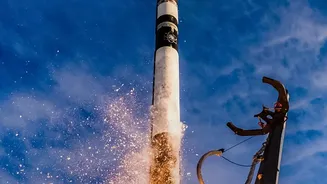
Every giant leap for mankind begins with a single, often quiet, step. For space exploration, one of those crucial first steps was taken on March 16, 1926. On a cold day in Auburn, Massachusetts, physics professor Robert Goddard launched the world's first liquid-fueled
rocket. It was a modest affair; the rocket, nicknamed "Nell," flew for just 2.5 seconds, reaching an altitude of 41 feet before landing in a cabbage patch. Yet, that brief flight was as significant to rocketry as the Wright brothers' first flight was to aviation. Goddard, a man inspired by the science fiction of H.G. Wells, had a vision of reaching extreme altitudes and even the Moon. While his contemporaries often dismissed his ideas as fantasy, Goddard possessed the scientific rigour to turn dreams into testable theories and, eventually, functional hardware.
A Lonely and Difficult Pursuit
Goddard's path was far from easy. He was a shy, serious scientist in an era when rocketry was not considered a respectable pursuit for a professor. His 1919 Smithsonian publication, "A Method of Reaching Extreme Altitudes," was a serious scientific paper, but the press seized upon its suggestion that a rocket could reach the Moon, earning him public ridicule. This experience made Goddard famously secretive for the rest of his life. He received very little government support, funding his early research himself before securing modest grants from the Smithsonian Institution and later, with the help of famed aviator Charles Lindbergh, the Guggenheim family. This support allowed him to move his operations from Massachusetts to the open desert of Roswell, New Mexico, where he could test his increasingly powerful rockets in relative seclusion.
The Foundational Innovations
Though his rockets never reached space, the principles Goddard developed and patented became the bedrock of modern rocketry. Over his career, he registered 214 patents. He was the first to prove that a rocket could work in a vacuum, needing no air to push against—a fundamental requirement for space travel. He pioneered the use of liquid propellants (liquid oxygen and gasoline), which offered far greater power than the solid fuels used before. Goddard also invented many of the systems that would become standard on future rockets. He developed gyroscopes for stability, vanes in the rocket exhaust for steering, fuel pumps, and self-cooling motors. He also patented the idea of a multi-stage rocket in 1914, a crucial concept for achieving the velocity needed to escape Earth's gravity. Essentially, Goddard built a toolkit of solutions for problems that future engineers at NASA would face.
From Patents to Launchpads
Robert Goddard died in 1945, over a decade before NASA was formed and before the Space Age truly began. He never saw his work fully realised on a grand scale. During his lifetime, his ideas found a more receptive audience in Germany, where scientists developing the V-2 missile studied his work. However, his legacy in the United States was cemented after his death. As American scientists began developing their own advanced rockets, they found that much of the foundational work had already been done by Goddard. His patents provided a blueprint for solving critical engineering challenges. In 1959, the U.S. government recognized his monumental contribution, posthumously awarding him a Congressional Gold Medal and naming NASA's new Maryland-based facility the Goddard Space Flight Center in his honor. The dedication of the centre occurred on March 16, 1961, the 35th anniversary of his first successful launch.