




A Messenger from Deep Space
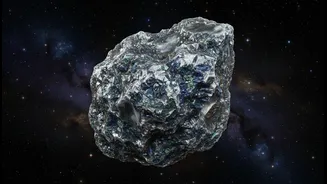
The visitor in question is a specific type of meteorite known as a CM1/2 carbonaceous chondrite. Let’s break that down. 'Carbonaceous chondrites' are ancient, carbon-rich meteorites that are essentially fossils from the birth of the solar system. They
are fragments of asteroids that never quite became planets. The 'CM' group is particularly famous for containing water-bearing minerals and the building blocks of life, like amino acids. The '1/2' classification is what makes this sample especially rare; it's an intermediate type between CM1 (heavily altered by water) and CM2 (less altered). It suggests the parent asteroid had a complex history with water, making it an incredibly valuable scientific specimen.
The Importance of Being Pristine
When a meteorite crashes to Earth, the clock starts ticking. Rain, humidity, and our own oxygen-rich atmosphere immediately begin to alter its delicate, ancient chemistry. This is why the term 'pristine' is so crucial. In the case of this new study, the meteorite was recovered incredibly quickly after it fell, preventing significant terrestrial contamination. This rapid recovery means scientists are looking at a sample that is as close as possible to how it was in space. It’s like finding an unblemished time capsule from over 4.5 billion years ago. This allows for the study of fragile minerals and organic compounds that are often destroyed or altered in other meteorite samples. The insights gained are therefore much more reliable.
What the New Study Found
The analysis of this pristine CM1/2 sample revealed a fascinating history. Scientists found evidence that its parent asteroid once had briny, or salty, liquid water flowing near its surface. This was deduced from the discovery of small, salt-rich fragments within the meteorite, likely formed where water evaporated on the asteroid. This finding is significant because it's a process not previously confirmed for this type of asteroid. Furthermore, the study confirmed a diverse suite of organic compounds and amino acids, the essential ingredients for life as we know it. The presence of both salty water and complex organics on an ancient asteroid bolsters the theory that these bodies could have seeded the early Earth with the materials necessary for life to emerge.
From Tiny Rock to Giant Asteroid
How can one small rock tell us so much about a giant asteroid hundreds of millions of kilometres away? Most meteorites are fragments blasted off larger asteroids by collisions in space. Therefore, studying a meteorite is a form of direct analysis of its parent body. While we can study asteroids from afar using telescopes and spectroscopy, these methods only give us a broad picture of their surface composition. A physical sample provides 'ground truth,' allowing scientists to calibrate their remote-sensing data. When a new and rare type of meteorite like this one is found, it provides a crucial new data point. It helps us understand the true diversity of materials that exist in the asteroid belt.
Sharpening Our Picture of the Cosmos
This is where we get to 'improving models.' Our current models of the solar system's formation and the composition of asteroids are built from all the data we have—telescopic observations, data from space missions like OSIRIS-REx, and analysis of other meteorites. A pristine sample from a rare class of asteroid is like getting a new, high-resolution pixel in a low-resolution image. This new data on water content, salt chemistry, and organic compounds will be fed into computer simulations. It will help scientists refine their understanding of where water-rich asteroids formed, how they evolved, and how many of them are out there. This makes our entire picture of the early solar system, including the delivery of water to Earth, much sharper and more accurate.
Why It Matters for India and the World
This research may seem abstract, but it has profound implications. Understanding the origins of Earth's water is fundamental to understanding our own existence. On a practical level, accurately mapping the location and composition of water-rich asteroids is critical for the future of space exploration. Water can be split into hydrogen and oxygen for rocket fuel, making asteroids potential refuelling stations for future deep-space missions. This is a field of growing interest globally, with agencies like ISRO also advancing India's capabilities in space. Better asteroid models also improve our ability to assess potential impact threats to Earth. This single study, born from a fallen rock, thus enhances our knowledge of our cosmic past and better prepares us for our cosmic future.