


A Cosmic Next-Door Neighbor
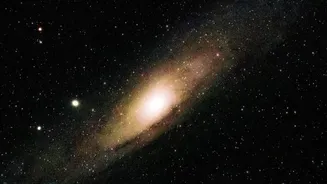
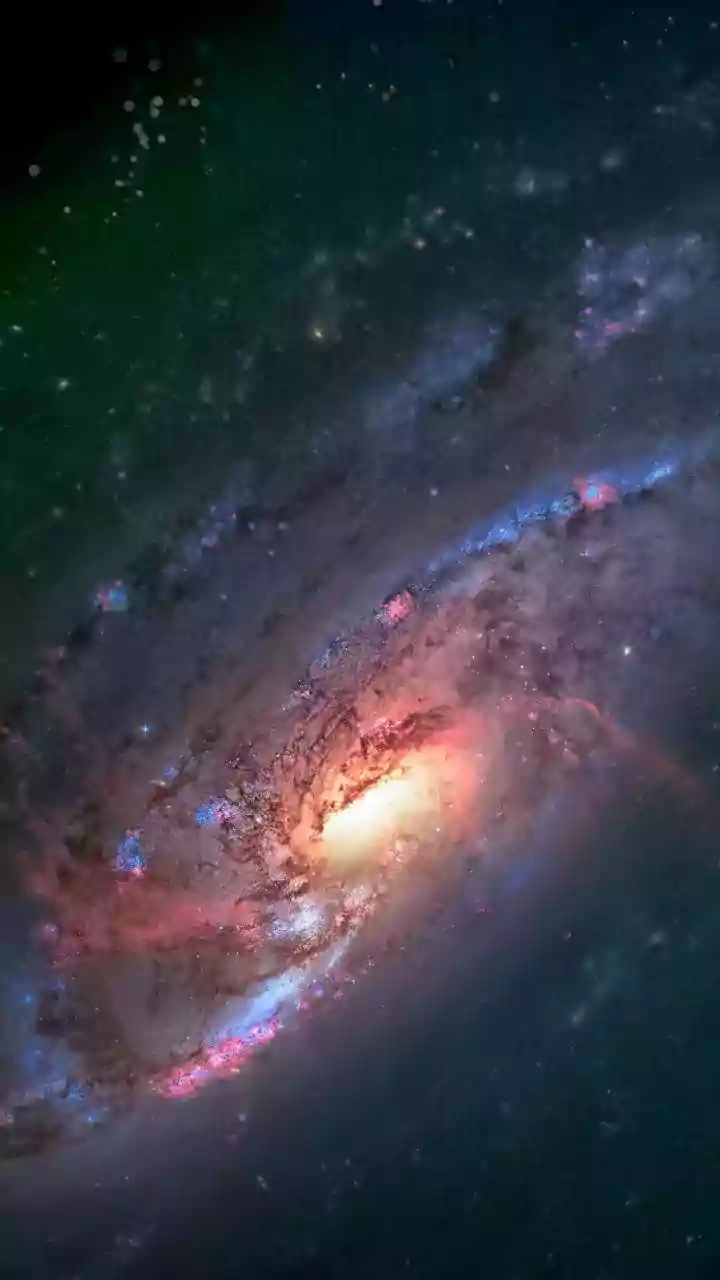
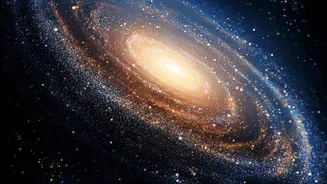
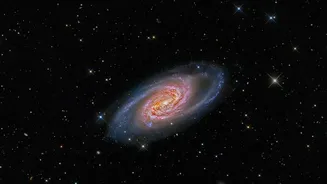
At just 2.5 million light-years away, the Andromeda galaxy (M31) is practically in our cosmic backyard. It's the nearest major spiral galaxy to our own Milky Way and so close that it's visible to the naked eye from dark-sky locations. This proximity makes
Andromeda an ideal natural laboratory. While we can study the Milky Way from the inside, Andromeda gives us a vital external perspective, allowing astronomers to see the entire structure of a large spiral galaxy at once. Studying its lifecycle helps us piece together the story of all galaxies, offering a unique opportunity to understand galactic formation and evolution.
Hubble's Unprecedented View
To unlock Andromeda's secrets, astronomers turn to the Hubble Space Telescope. For over three decades, Hubble's sharp vision has been critical. It is the only telescope capable of resolving millions of individual stars within Andromeda, a task that requires incredible spatial resolution over a vast area. Recent studies have combined data from two massive surveys—the Panchromatic Hubble Andromeda Treasury (PHAT) and its southern counterpart, PHAST—which together mapped about two-thirds of the galaxy's sprawling disk. By analyzing the light from approximately 200 million individual stars, scientists can read the galaxy's 'fossil record' and reconstruct its history.
A Galaxy Winding Down
The latest findings reveal a dramatic story of change. While Andromeda experienced a massive burst of star formation about 2 billion years ago, likely from a merger with another galaxy, its productive era is now winding down. A new analysis shows that star production in Andromeda has been steadily declining for the last 500 million years. Five hundred million years ago, it was creating stars at a rate of about one solar mass per year—similar to the Milky Way today. However, that rate has plummeted, dropping by half by 40 million years ago and now sitting at just one-fifth of a solar mass per year. This slowdown suggests Andromeda is transitioning from a vibrant, star-forming spiral to a quieter galaxy dominated by older stars.
The Stellar Fossil Record
Stars serve as time capsules. Massive, hot stars burn blue and die young, so their presence indicates recent star formation. Conversely, areas dominated by redder, less massive stars are older. By categorizing stars by their color and brightness across thousands of different regions of Andromeda, astronomers can create a detailed map of its star-forming history. The recent decline in star birth appears most pronounced in a prominent ring about 32,000 light-years from the galactic center. This detailed analysis shows the galaxy isn't running out of the raw gas needed for stars, but rather seems to be naturally slowing down after its more active past.
Clues to a Violent Past and Future
Andromeda's history appears more violent and active than our own Milky Way's. The major starburst 2 billion years ago, along with streams of stars in its halo, points to a past filled with galactic mergers and acquisitions. Some researchers suspect a recent interaction with the dwarf galaxy M32, a companion to Andromeda, might have influenced the star formation rate in nearby regions within the last 60 million years. These discoveries don't just tell us about Andromeda's past; they also inform our future. The two galaxies are on a collision course, predicted to merge in about 4-5 billion years to form a new, giant elliptical galaxy. Studying Andromeda's current evolution helps us model what that cosmic collision might look like.