







In a landmark achievement for space exploration, SpaceX successfully caught the upper stage of its Starship rocket at its Texas launch site. This historic maneuver, part of the vehicle's 15th test flight, is a pivotal step toward a fully reusable system.
A Groundbreaking Recovery
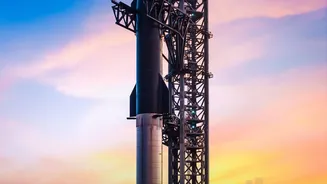
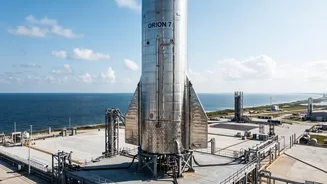
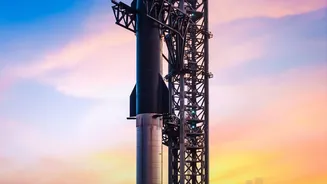
On Saturday, November 14, 2026, after orbiting the Earth for nearly 23 hours, the Starship upper stage (known as Ship 42) descended from the sky and was caught by the giant mechanical arms of the launch tower at Starbase, Texas. The maneuver, which had never been attempted with an upper stage returning from orbit, marked a monumental success for SpaceX's ambitious Starship program. The mission, designated Flight 15, began the day prior with a launch that also deployed 26 Starlink internet satellites into orbit. While the full mission objective included catching the Super Heavy booster as well, that part of the plan was aborted due to a low fuel alarm, leading to a controlled splashdown in the Gulf of Mexico. Despite this, the successful recovery of the upper stage alone represents a major leap forward.
The 'Chopsticks' Catch Explained
The method for this unprecedented recovery involves the launch tower itself, nicknamed 'Mechazilla', which is equipped with two large, mobile arms often called 'chopsticks'. Instead of the spacecraft landing on legs, it positions itself between these arms during its final descent. The arms then close around the vehicle to secure it. This innovative system is central to SpaceX's vision of rapid reusability. By eliminating the need for heavy, complex landing legs on the vehicle, Starship can reduce its weight, which in turn increases its payload capacity. Furthermore, catching the rocket with the tower places it directly at the launch mount, theoretically allowing for much faster inspection, refueling, and preparation for its next flight, mimicking the turnaround of a commercial aircraft.
Why This Changes Everything
The successful catch of a Starship upper stage is more than just a technical feat; it is a proof-of-concept for the holy grail of spaceflight: a fully and rapidly reusable orbital launch system. Until now, upper stages of orbital rockets have been expendable, burning up on reentry or being discarded in the ocean. Recovering and reusing them has been seen as a critical, but incredibly difficult, step toward dramatically lowering the cost of access to space. During a livestream, a SpaceX spokesperson captured the sentiment, stating, 'We caught a Starship, and now everything changes'. This achievement moves the company closer to its goal of launching missions to the Moon, Mars, and beyond with a frequency and cost that were previously unimaginable. Elon Musk has suggested the recovered spacecraft could fly again within weeks after refurbishment.
The Long Road of Flight 15
This success didn't come easily. Flight 15 was an ambitious, 22.5-hour mission that saw the Starship upper stage circle the planet 14 times after its launch on November 13. After deploying its satellite payload, the vehicle spent hours in orbit while teams on the ground monitored its systems to ensure it was healthy enough for the risky return attempt. The spacecraft then performed a deorbit burn, plummeting back through Earth's atmosphere in a 'belly flop' maneuver to scrub off speed before reorienting itself upright for the final powered descent and catch. This was only the second time a Starship had reached orbit, making the successful recovery even more impressive and vital for the program's progress.
What's Next for Starship?
While celebrating this major victory, SpaceX still has work to do. The next major milestone will be to successfully execute a 'double catch'—recovering both the Super Heavy booster and the Starship upper stage on the same mission. Engineers will also be thoroughly inspecting the recovered Ship 42 to understand how it withstood the stresses of launch, orbital flight, and atmospheric reentry. The data gathered will be invaluable for making improvements and validating that the vehicle can be quickly and reliably prepared for another flight. This progress is crucial as SpaceX is under contract with NASA to use Starship as a lunar lander for the Artemis program, which aims to return humans to the Moon by 2028.