





An Indian Breakthrough in Martian Weather
Researchers at the Physical Research Laboratory (PRL) in Ahmedabad have unveiled a fascinating discovery about the climate of Mars. A study published in the journal Current Science reveals how some of the largest impact basins on the Red Planet directly
influence its atmospheric temperature, creating enormous, wave-like patterns that ripple across the globe. This breakthrough provides crucial new insights into the planet’s weather system. The research team used data from the Emirates Mars Mission's Hope spacecraft, demonstrating a powerful example of international scientific collaboration. This work builds on India’s legacy in planetary science, which saw a major milestone with the successful Mars Orbiter Mission, or Mangalyaan, launched in 2013.
Giant Craters and Atmospheric Ripples
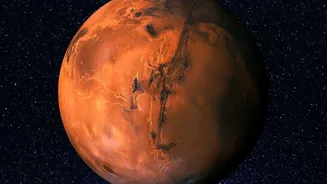
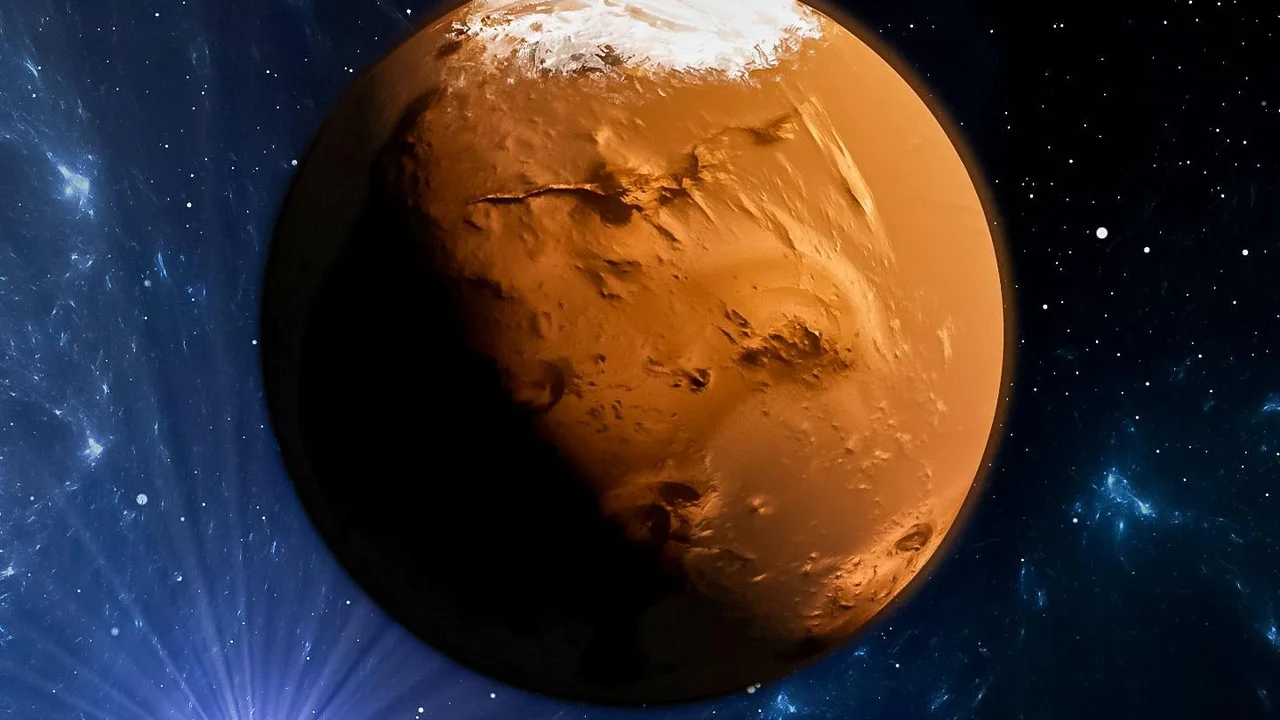
Imagine the wind flowing over a huge mountain range on Earth. The terrain forces the air to move, creating waves in the atmosphere. Something similar, but on a planetary scale, is happening on Mars. The new PRL research focuses on two colossal impact basins, Hellas and Argyre. These aren't just craters; they are massive depressions in the Martian surface. As Mars's thin atmosphere flows over and through these deep basins, it generates large-scale atmospheric waves, known as zonal waves. These waves then travel through the atmosphere, causing temperatures to rise and fall in a predictable, wave-like pattern across different regions.
A Tale of Two Basins
The study found that the effect is not the same everywhere. The two basins, Hellas and Argyre, create distinctly different atmospheric patterns. Over the Argyre basin, the scientists observed a broad, uniform wave pattern, which they call a 'wave-1' pattern. However, the atmosphere above the much larger and deeper Hellas basin is far more complex. There, researchers identified more intricate 'wave-2' and 'wave-3' patterns, indicating multiple atmospheric waves interacting. This difference shows that the specific size and depth of these geological features play a critical role in shaping Mars’s global weather. Temperatures across these regions can swing wildly, from a relatively mild 22 degrees Celsius down to a frigid minus 123 degrees Celsius.
Improving Our Martian Forecasts
So, why does mapping these temperature waves matter? The answer is crucial for the future of Mars exploration. For any robotic rover or future human mission to operate safely on Mars, we need accurate weather forecasts. The PRL team compared their real-world observations with existing climate models, like the Mars Climate Database. They found that the models were often about 10 Kelvin (or 10 degrees Celsius) cooler than what the spacecraft actually measured. This discovery helps scientists pinpoint and correct the gaps in our current climate models, making them more accurate. Better models mean better predictions for dust storms, temperature drops, and other atmospheric phenomena that could affect missions.
India's Growing Role in Space Science
This research is more than just a weather report for another planet. It solidifies the role of Indian scientists at the forefront of planetary science. By leveraging international datasets and building on the expertise gained from missions like Mangalyaan, institutions like PRL are making fundamental contributions to our understanding of the solar system. Discoveries like these not only expand human knowledge but also pave the way for more ambitious future projects, including advanced robotic explorers and, one day, crewed missions to the Red Planet. Each finding brings us one step closer to understanding how Mars evolved into the planet it is today and what its future might hold.