



The Ghost Particles of the Cosmos
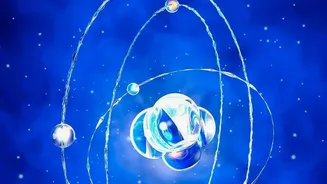
Neutrinos are fundamental particles, often called “ghost particles” because they barely interact with other matter. Trillions pass through you every second unnoticed. They are born from nuclear reactions, like those inside stars. When a truly massive
star, many times the size of our sun, ends its life, its core implodes under its own gravity, unleashing a staggering flood of about 10 to the power of 58 neutrinos. These particles carry away 99% of the energy from the star's collapse. Neutrinos come in three types, or “flavours”: electron, muon, and tau. For a long time, scientists believed their role in a supernova, while important for energy transport, was relatively straightforward. However, it turns out these particles have a quantum trick up their sleeve that could change everything.
A Star's Explosive Death
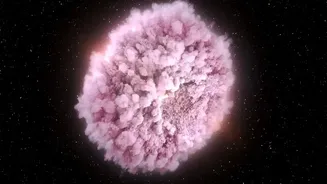
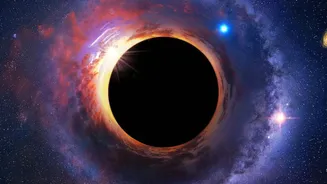
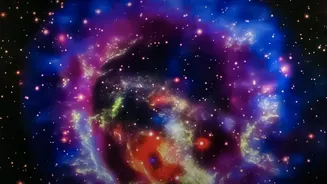
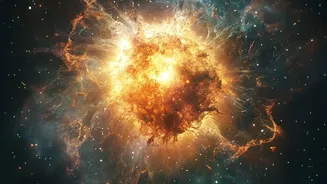
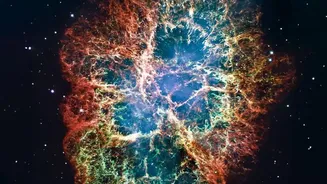
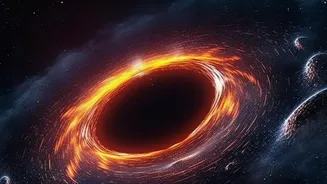
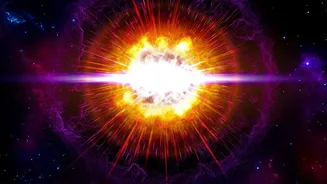
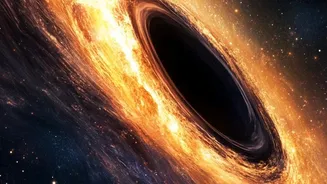
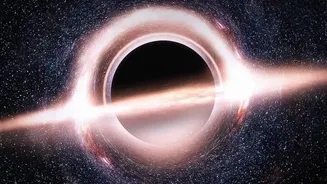
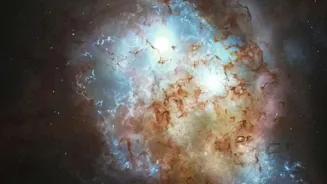
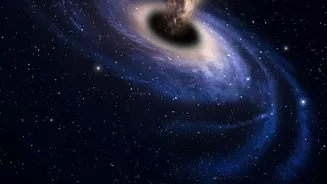
The end for a massive star begins when it runs out of fuel. Without the outward push of nuclear fusion, gravity wins. The core collapses in on itself in less than a second, crushing protons and electrons together to form neutrons and generating that immense blast of neutrinos. This collapse creates a powerful shockwave that starts moving outwards. But the shockwave often stalls, fighting against the immense pressure of the star's outer layers still falling inwards. The established theory is that a small fraction of the escaping neutrinos are absorbed by the material behind the shockwave, reheating it and giving it the new momentum needed to finally tear the star apart in a glorious supernova. But sometimes, this reheating fails, and the entire star collapses, forming a black hole.
A Cosmic Tipping Point
This is where the neutrinos' flavour-changing trick comes in. In the incredibly dense environment of a collapsing star, neutrinos are so crowded they can interact with each other, causing them to rapidly switch identities in a process called “fast flavour conversion.” An electron neutrino might become a muon or tau neutrino, and vice-versa. This is crucial because different flavours interact with matter differently. Electron neutrinos are more effective at being absorbed by the stellar material and reheating the stalled shockwave. Recent studies simulating the collapse of hundreds of stars have shown that if these fast flavour conversions occur, they can significantly alter the number of electron neutrinos available to push the shockwave. In some cases, particularly for stars between 16 and 30 times the mass of our sun, this flavour-switching can be the deciding factor that causes the explosion to fail, leading to the formation of a black hole instead of a supernova.
The Next Frontier: Realistic 3D Models
While this theory is compelling, there's a major hurdle: proving it. Fast flavour conversions are a chaotic, three-dimensional phenomenon. They happen on incredibly short timescales and depend heavily on the direction the neutrinos are travelling. Most current supernova simulations are done in one or two dimensions to save on computational cost. These simpler models can't capture the complex, turbulent nature of the process and may miss crucial details. Researchers are in a global race to develop the software and supercomputing power needed for full, high-fidelity 3D simulations that incorporate these complex neutrino physics. These future models are essential to confirm just how significant this flavour-changing mechanism is and to finally build a complete picture of how the universe's most massive stars meet their end.