

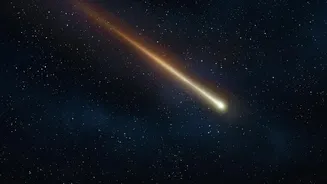
A Celestial Photobomb
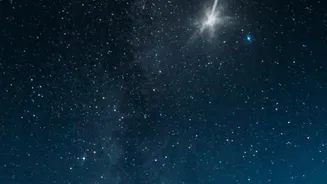
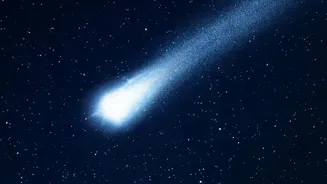
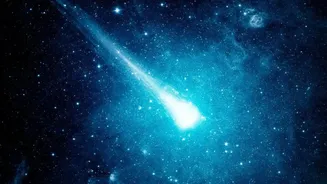
On August 3, 2026, NASA released a stunning image that has captivated astronomers and stargazers alike. Captured during a long exposure of the Lacerta Nebula, a bright meteor unexpectedly streaked across the frame. This celestial 'photobomb' provides
more than just a beautiful accident; the glowing trail is a transient scientific laboratory. The meteoroid, likely no bigger than a pebble, created a luminous streak as it burned up in Earth's atmosphere. The image, taken from Nevada, USA, offers a perfect, timely example of the ephemeral events that scientists are racing to study for the wealth of data they contain. This picture serves as a powerful reminder that August is a prime month for meteor viewing, with several showers active, including the prominent Perseids.
The Science of a Fiery Trail
When a meteoroid enters our atmosphere at high speed, it's not just the friction that creates the light we see. The intense heat vaporises the rock itself, leaving a trail of superheated gas and dust. This process excites the atoms of different elements within the meteor, causing them to emit light at specific, characteristic wavelengths. This is the science of spectroscopy, a technique that acts like a cosmic fingerprint scanner. By capturing the light from the meteor and splitting it into its component colours, like a prism creating a rainbow, scientists can identify the exact elements present. Each element—like magnesium, iron, or sodium—glows with a unique colour signature when vaporised, telling a story about the meteor's composition.
Reading a Meteor's Barcode
This spectral analysis is a powerful, non-destructive tool for understanding celestial objects. For instance, a strong green hue in a meteor's trail is often an indicator of magnesium, while a yellowish-orange light points to sodium. NASA has ongoing projects, including the Meteor Composition Determination (Meteor) experiment on the International Space Station, dedicated to capturing these fleeting events from above the atmosphere. Observing from space avoids interference from weather and the atmosphere itself, allowing for clearer, more detailed spectral data. This data helps scientists determine not just the chemical makeup but also properties like the size and density of the original meteoroid.
Time Capsules from the Early Solar System
So, why does this all matter? Because meteors are essentially leftovers from the formation of our solar system more than 4.5 billion years ago. They are time capsules containing the original building blocks of planets. By analysing the mineral composition of these ancient rocks, scientists can piece together the conditions of the early solar system. The relative amounts of different elements and minerals provide crucial clues about the processes that formed planets like Earth. Studying the minerals in different types of meteorites helps researchers understand the history and evolution of their parent bodies, such as asteroids and comets.
Unlocking Clues to Our Own Origins
The study of vaporising minerals extends to profound questions about our own existence. Certain types of meteorites, known as carbonaceous chondrites, have been found to contain complex organic chemicals, including the amino acids that are the building blocks of proteins. This suggests that meteor impacts on early Earth may have delivered some of the key ingredients necessary for life to emerge. Furthermore, understanding how meteors break apart and vaporise upon atmospheric entry is critical for planetary defence. Research into how minerals like iron sulfide vaporise helps create more accurate models to predict the behaviour and potential impact risk of incoming asteroids.