






The Old View of Rain
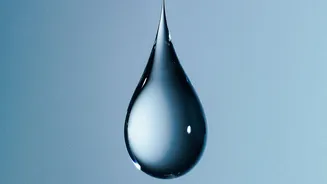
For centuries, we’ve understood that rain wears things down. This process, known as splash erosion, is the first step in water-driven soil loss. Scientists knew that the impact of a raindrop dislodges soil particles, which are then washed away by runoff.
The general thinking was that this was a slow, grinding process of physical abrasion, where the collective force of countless drops over millennia gradually wore down surfaces. The exact mechanics, however, remained something of a mystery, mostly studied by observing the aftermath with high-speed cameras. This view saw erosion as a war of attrition, where persistence, not power, was the primary weapon of the rain.
A Shocking Discovery
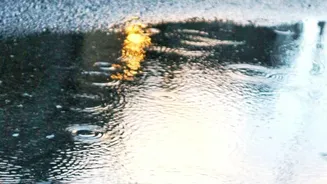
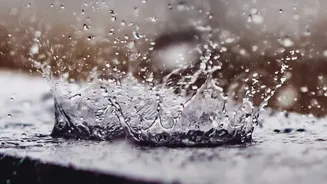
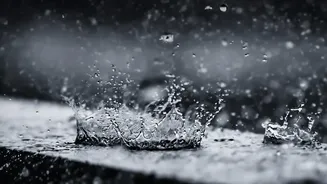
A new study, led by researchers at the University of Minnesota, has completely upended this traditional view. Using a novel technique called high-speed stress microscopy, scientists were able to measure the hidden forces and pressures underneath a liquid droplet at the moment of impact. What they found was astonishing. Rather than being concentrated at the centre, the force of the impact spreads out with the droplet. For a fraction of a second, the edge of the spreading water exceeds the speed of sound, creating a shock wave across the surface. This changes everything. Each raindrop doesn't just tap the surface; it behaves like a miniature bomb, releasing its energy in an explosive burst.
The Power of a Single Drop
This explosive release of energy explains how something as soft as water can exert enough force to damage hard materials over time. The concept of 'shear stress' is key here—it’s the force that pushes in opposite directions across a material. The shockwave from the raindrop generates immense shear stress, which is powerful enough to initiate tiny cracks and weaknesses in even the most resilient surfaces, from rock to concrete. It’s not just about the downward force; it’s about the explosive sideways expansion. This finding finally provides a clear physical explanation for the age-old saying, showing that the impact is far more violent on a microscopic scale than we ever imagined.
Rethinking Geological Time
This new understanding has profound implications for geology and how we model the evolution of landscapes. Weathering—the breaking down of rocks and minerals—is a fundamental geological process. While chemical weathering (like acid rain dissolving rock) is well-understood, the pure mechanical force of rain has been harder to quantify. This study shows that mechanical weathering from rain is not just a gentle sanding process but a series of high-energy impacts. Geologists can now factor this explosive force into models that predict how mountain ranges like the Himalaya are shaped and how landscapes change over millions of years. It suggests that the rate of erosion in some environments might be faster than previously thought, especially in areas with intense rainfall.
From Farms to Wind Turbines
The study’s impact extends far beyond geology. In agriculture, soil erosion is a critical issue that affects crop yields and food security. Understanding that each raindrop hits bare soil with explosive force underscores the vital importance of cover crops and no-till farming, which protect the soil with a layer of vegetation. The findings are also crucial for engineering. Materials used for buildings, roads, and even wind turbine blades are constantly exposed to the elements. By understanding the exact nature of the stress caused by raindrops, engineers can design more durable, erosion-resistant coatings and materials, potentially saving billions in maintenance and replacement costs over the long term.