




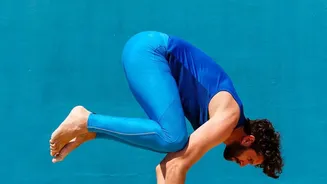


Yoga: The Art of Standing Still
At its core, improving balance is about training your body to know where it is in space—a sense known as proprioception. Yoga's standing poses are a masterclass in this. When you hold a posture like Tree Pose (Vrikshasana) or Warrior III, you’re not just
strengthening muscles. You are creating a conversation between your brain, joints, and muscles. Millions of tiny sensory receptors in your muscles and joints send constant feedback to your brain about your position, and your brain sends back signals to make micro-adjustments to keep you upright. This process strengthens the neural pathways responsible for stability. By intentionally challenging your equilibrium in a controlled way, you are essentially upgrading your body’s internal GPS, making you less susceptible to unexpected trips and sways in daily life.
Rewiring the Brain for Stability
The magic of yoga for balance lies in its deliberate, mindful nature. Holding a challenging pose forces your mind to focus, filtering out distractions and tuning into the subtle shifts of your body. This intense concentration shifts brainwave patterns into a more tranquil state, but it also does something more profound: it promotes neuroplasticity. This is the brain's ability to reorganise itself by forming new neural connections. Unlike repetitive cardio, the novelty and challenge of holding a one-legged stance or transitioning smoothly between poses forces your brain to build new pathways, improving not just physical balance but also cognitive functions. It’s a workout for your brain just as much as your body, enhancing its ability to process sensory information and react accordingly.
Skipping: The Science of Quick Reactions
If yoga builds balance through stillness, skipping builds it through dynamic, repetitive motion. Skipping is a form of plyometric exercise, which involves quick, explosive movements designed to increase power and speed. At the heart of this is the stretch-shortening cycle: a rapid muscle stretch (as you land) immediately followed by a powerful contraction (as you jump). This cycle trains your fast-twitch muscle fibres, which are crucial for quick, explosive actions. The constant, rhythmic hopping demands that your brain and muscles communicate with incredible speed, sharpening the efficiency of your neuromuscular system. Each turn of the rope is a new problem to solve in milliseconds, forcing your body to become highly adaptive.
Training Nerves to Fire Faster
Quick reflexes are not just about muscle; they're about the speed of your nervous system. Skipping trains your brain to send signals to your muscles more rapidly. To avoid tripping, you must constantly coordinate the movement of your hands, feet, and eyes, timing each jump with precision. This trains your reaction time and agility, which is the ability to change direction and speed quickly. Over time, this practice enhances your nervous system's responsiveness, making you quicker to react not only to the rope but also to unpredictable events, like catching a falling glass or sidestepping an obstacle on the pavement. The skills are highly transferable, improving coordination for other sports and enhancing your ability to move confidently through the world.
Better Together: Stability Meets Agility
While yoga and skipping develop different aspects of physical control, they are not mutually exclusive. In fact, they are highly complementary. Yoga provides static balance—the ability to hold steady in one position—by strengthening your core and improving proprioception. Skipping, on the other hand, develops dynamic balance—the ability to stay stable while in motion. A well-rounded fitness routine benefits from both. Yoga builds the foundational stability and body awareness that can help prevent injuries during high-impact activities like skipping. Meanwhile, skipping provides the cardiovascular and reactive-strength benefits that yoga's slower practice may not emphasise. Together, they create a body that is both gracefully stable and powerfully agile, ready for whatever movement life demands.