



Our Seasons: A Story of Tilt
First, let’s talk about Earth. It’s a common misconception that our seasons are caused by how close our planet is to the Sun. In reality, Earth’s orbit is nearly a perfect circle. The real reason for our seasons is our planet's axial tilt, which is about 23.5
degrees. When the Northern Hemisphere is tilted toward the Sun, we get direct sunlight and experience summer, while the Southern Hemisphere is tilted away and has winter. The distance from the Sun doesn't change much, so our seasons are relatively mild and evenly spread throughout the year. This consistent tilt provides the predictable rhythm of life on Earth that we are all familiar with.
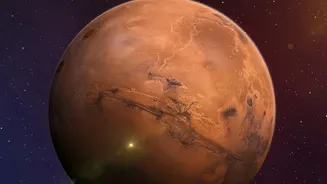
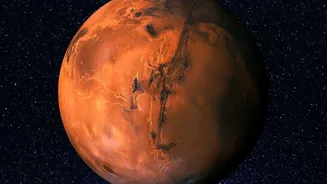
Mars: A Tale of Tilt and Travel
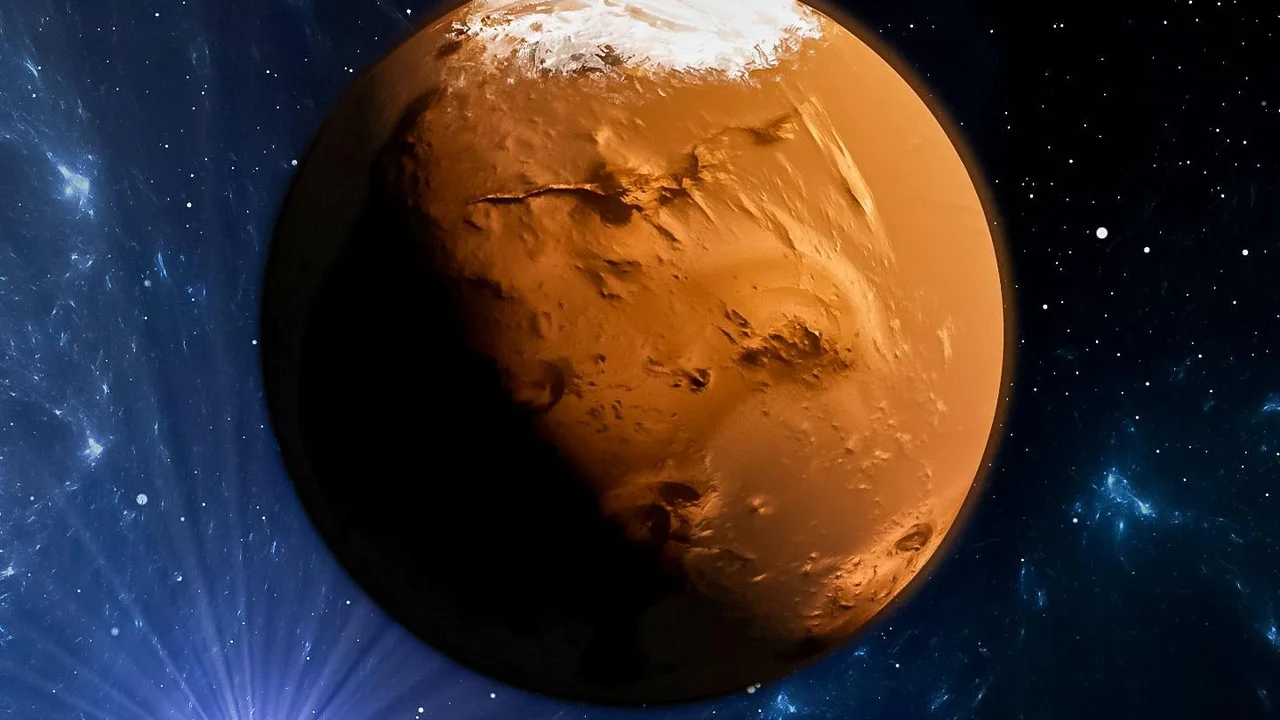
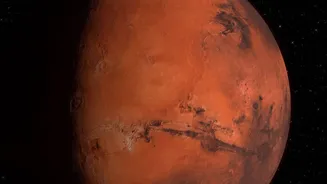
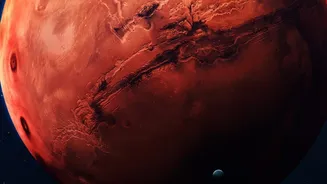
Mars also has an axial tilt, and it's remarkably similar to ours at about 25 degrees. This tilt is the primary driver of its seasons, creating spring, summer, autumn, and winter just like on Earth. However, Martian seasons are far from predictable or even in length. This is because Mars has a second major factor at play: its highly eccentric, or egg-shaped, orbit. While Earth’s distance from the Sun barely wavers, Mars's distance varies significantly. This combination of a tilted axis and a lopsided orbit is the secret behind its chaotic and extreme seasonal shifts.
The Egg-Shaped Journey
An orbit’s eccentricity is a measure of how much it deviates from a perfect circle. Mars has one of the most eccentric orbits of any planet in our solar system. This means its distance from the Sun changes dramatically over its 687-day year. At its closest point, known as perihelion, Mars receives about 40% more solar energy than at its farthest point, or aphelion. This massive swing in solar radiation has a profound effect on the planet’s temperature and weather, amplifying the seasonal changes caused by its tilt in a way that simply doesn’t happen on Earth.
A Cosmic Coincidence with Extreme Consequences
The true drama unfolds because of how Mars’ tilt and orbit align. The planet reaches perihelion (closest to the Sun) during summer in its southern hemisphere. This makes southern summers incredibly hot but also short, because the planet moves faster in its orbit when it is closer to the Sun. Conversely, the northern hemisphere experiences its summer when Mars is at aphelion (farthest from the Sun). This results in northern summers that are long, cool, and mild. As a result, the seasons on Mars are wildly uneven. Northern spring is the longest season at 194 Martian days (sols), while northern autumn is the shortest at just 142.
Fuel for Planet-Sized Dust Storms
This uneven heating does more than just create lopsided seasons; it fuels some of the most violent weather in the solar system. The intense heat during the southern summer, when Mars is nearest the Sun, warms the thin atmosphere and creates powerful winds. These winds can kick up fine Martian dust, generating enormous dust storms. These aren't just local squalls; they can grow to the size of continents and sometimes merge into a single, global storm that shrouds the entire planet for weeks, blocking out the sun and causing temperatures to plummet. This phenomenon is a direct consequence of the extra energy pumped into the atmosphere during the planet's closest approach to the Sun.