

Myth 1: The Water Test
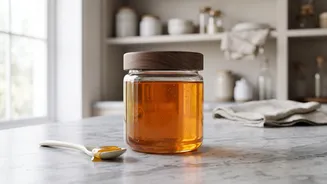
The most common hack suggests dropping honey into a glass of water; if it sinks in a lump, it’s pure, and if it dissolves, it's fake. This sounds simple, but it's not a reliable test for purity. The behaviour of honey in water depends on its viscosity
and density, not just its authenticity. Honey is naturally water-soluble. A thick, dense honey (pure or adulterated) will sink, while a thinner, less viscous pure honey might start to dissolve. Sophisticated adulterants like high-density rice syrup are specifically designed to be thick and will sink just like real honey, easily passing this test. A study even found the water test is poor at detecting corn syrup adulteration.
Myth 2: The Flame Test
Another popular 'test' involves dipping a matchstick or cotton wick in honey and trying to light it. The theory is that pure honey will burn, while fake honey won't because of added moisture. This is not only a dangerous kitchen experiment but also a flawed one. Honey's ability to burn is determined by its moisture content, which naturally varies. Pure, raw honey can have a moisture level high enough to prevent it from igniting easily. Conversely, some adulterated syrups might have a low enough moisture content to catch fire. This test reveals more about moisture than it does about adulteration.
Myth 3: The Crystallization Test
Many people believe that if their honey turns solid or grainy, it has spoiled or contains added sugar. The opposite is actually true. Crystallization is a natural process for raw, unprocessed honey and is often a sign of authenticity. It happens when glucose, one of the main natural sugars in honey, separates from the solution. Different types of honey crystallize at different rates depending on their unique glucose-to-fructose ratio. In fact, many commercial brands heat-treat their honey specifically to prevent crystallization and keep it liquid on shelves, a process that can destroy beneficial enzymes.
Why These Hacks Are Deceiving
The fundamental problem with these home tests is that they assess simple physical properties like thickness, stickiness, and moisture content. However, honey is an incredibly variable natural product. Its characteristics are influenced by the type of flower nectar the bees collected, the climate, the season, and how it was handled after harvesting. There is no single universal standard for what pure honey should look or feel like. Adulteration has also become highly sophisticated. Producers of fake honey now use engineered syrups made from rice, corn, or beets that are designed to mimic the physical properties of real honey and evade simple tests.
What Actually Proves Purity?
Detecting modern adulterants requires advanced scientific methods in a laboratory. Techniques like Nuclear Magnetic Resonance (NMR) profiling and Isotope Ratio Mass Spectrometry (IRMS) are used to analyse the molecular structure of the honey. These tests can identify foreign sugars from sources like corn and sugarcane (C4 plants) or rice and beets (C3 plants) that don't belong in honey made from flower nectar. A 2020 investigation by the Centre for Science and Environment (CSE) in India found that many major brands that passed basic tests failed advanced NMR screening, revealing widespread, sophisticated adulteration.
Smarter Ways to Choose Good Honey
Since you can't run an NMR test in your kitchen, the best strategy is to become an informed shopper. First, read the label carefully. Pure honey should have only one ingredient: honey. Be wary of vague terms like 'honey blend'. Second, look for certifications. While not foolproof, an FSSAI license is a basic requirement. Some brands go further and provide NMR test reports on their websites. Third, know your source. Buying from trusted local beekeepers or brands that are transparent about their specific sourcing region (e.g., 'Himalayan wild forest' instead of just 'Product of India') can increase your chances of getting an authentic product.