





A Mission That Keeps on Giving
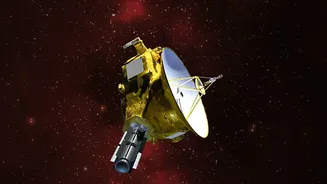
Launched in 2006, NASA's New Horizons spacecraft was tasked with a historic mission: the first-ever flyby of Pluto. In 2015, it delivered breathtaking images that transformed the dwarf planet from a distant blur into a complex world with ice mountains,
nitrogen glaciers, and a thin atmosphere. But its journey didn't end there. After the Pluto encounter, the probe continued its voyage into the Kuiper Belt, a vast, doughnut-shaped ring of icy bodies orbiting the Sun beyond Neptune. In 2019, it visited Arrokoth, the most distant object ever explored by a spacecraft. Now, billions of kilometres from home, New Horizons is still making profound discoveries, peering into the darkness to reveal the secrets of our solar system's formation.
A Glimmer in the Dark
The latest bombshell comes not from a new flyby, but from a fresh analysis of data collected years ago at Pluto. Recent studies published in the Planetary Science Journal reveal compelling evidence suggesting that liquid might have recently flowed on Pluto's surface. The focus is on Sputnik Planitia, the vast, heart-shaped glacier of frozen nitrogen. Images show dark streaks and patches along the boundaries of large, polygonal cells of ice. On Earth, similar features on glaciers are caused by wetting from meltwater. While rain is impossible in Pluto's thin, frigid atmosphere, the patterns strongly suggest a liquid has darkened the surface, forcing scientists to look for a source from below.
Not Water, But Something Colder
In the extreme cold of the outer solar system, where surface temperatures hover around -230 degrees Celsius, liquid water is out of the question. The candidate for this surprising activity is liquid nitrogen. Scientists theorise that, under the immense pressure of the miles-thick nitrogen glacier, the ice at its base could melt. This liquid nitrogen, slightly denser than the solid ice, would then be forced upward through cracks and fissures, briefly seeping onto the surface before freezing again. This process is a form of cryovolcanism — volcanic activity involving icy materials instead of molten rock. The presence of ammonia hydrates on other Kuiper Belt Objects like Charon also points to cryovolcanic processes that could bring liquid to the surface.
What It All Means
The possibility of active, flowing liquids on Pluto is a game-changer. It suggests that even in the most frigid, distant corners of our solar system, geological activity can occur. These worlds aren't the dead, inert snowballs we once imagined. Instead, they may have complex internal processes, driven by pressure and the slow decay of radioactive elements in their cores, which can generate enough heat to keep substances like nitrogen liquid deep underground. This finding has significant implications, suggesting that other large Kuiper Belt Objects, like Neptune's moon Triton or the dwarf planet Eris, might also harbor similar activity. It expands the range of environments where dynamic planetary processes can happen.
The Journey Continues
While the evidence for liquid nitrogen on Pluto is compelling, it remains indirect. Scientists need more data to confirm the hypothesis, a difficult task given the immense distance. In the meantime, New Horizons continues its journey into the outer heliosphere, the boundary between our solar system and interstellar space. Having recently woken from a long hibernation period in July 2026, the healthy spacecraft is studying the solar wind and cosmic dust. The mission has been extended, and while it may not have another close flyby target, it serves as our most distant observatory, constantly measuring the environment of a region we are only just beginning to understand. Each new piece of data it sends home helps piece together the puzzle of our cosmic neighbourhood.