







What Is This New AI?
Meta has unveiled a groundbreaking system named Brain2Qwerty v2, an AI model designed to translate brain activity into text in real-time. Unlike many high-profile brain-computer interfaces (BCIs), such as those from Neuralink which require surgical implants,
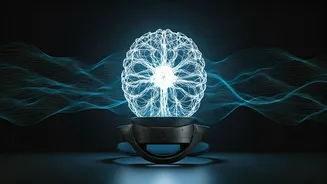
Meta's approach is entirely non-invasive. The system uses a helmet-like device equipped with magnetoencephalography (MEG) sensors, which measure the faint magnetic fields produced by the brain's neural activity. The AI is then trained to recognize the specific patterns associated with intended speech or typing, learning to decode whole words and sentences directly from these external scans. This leap forward represents a significant shift, making advanced BCI technology potentially safer and more attainable for a much wider audience.
How It Achieves Unprecedented Accuracy
The secret to Brain2Qwerty's success lies in its sophisticated use of AI and vast amounts of data. Researchers trained the v2 model on over 22,000 sentences from participants who spent around 10 hours each wearing an MEG scanner while typing. This massive dataset allowed the deep learning model to get exceptionally good at correlating brain signals with language. The system doesn't just guess letters; it uses a multi-level approach, leveraging large language models (LLMs) to understand semantic context and assemble coherent sentences from the noisy brain data. This method has yielded remarkable results, achieving an average word accuracy of 61%, with top participants reaching as high as 78%. That's a dramatic improvement over previous non-invasive methods, which hovered around just 8% accuracy.
The 'Accessible' Breakthrough Explained
The term "accessible" is key. By eliminating the need for neurosurgery, Meta's BCI sidesteps the significant risks, costs, and logistical hurdles associated with invasive implants. Surgery is a major barrier, limiting current BCI applications to a small number of clinical trial participants. A non-invasive system, even if currently reliant on bulky and expensive MEG machines, points toward a future where the technology could be deployed more broadly. The immediate and most profound application is in healthcare. For millions of people who have lost the ability to speak due to conditions like ALS, stroke, or paralysis, this technology could restore communication and dramatically improve their quality of life.
More Than Just Mind Reading
It's important to clarify what this technology does and doesn't do. Brain2Qwerty is not reading your random, inner thoughts. The system is specifically trained to decode the motor and language intentions associated with producing speech or typing. It works by recognizing the brain patterns for words you consciously intend to communicate. While the sci-fi trope of telepathy is still a long way off, the current breakthrough is focused on a more practical and ethical goal: giving a voice to the voiceless. By making the underlying code open source, Meta hopes to accelerate research across the field, allowing other scientists to build upon this work to diagnose and treat neurological disorders more effectively.
The Long Road to a Silent Keyboard
Despite the impressive leap forward, there are still significant challenges to overcome before this technology is ready for widespread use. The primary obstacle is the hardware itself. Current MEG scanners are massive, expensive, and require magnetically shielded rooms, making them completely impractical for home or clinical use. While promising advancements are being made in smaller, more portable MEG sensors, they are not yet a reality. Furthermore, while a 61-78% accuracy rate is a huge scientific achievement, it's not yet reliable enough for seamless daily communication. This research is a crucial proof of concept that challenges the long-held belief that only invasive methods could yield high performance, paving the way for a future where you might one day control your devices with nothing but your thoughts.