



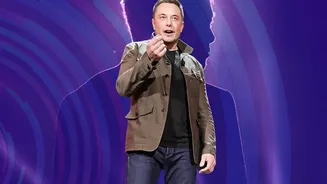
The Case Against Hyper-Specialisation
For decades, career advice has centred on a single idea: specialise. Find a niche, become the expert, and build a secure career. Elon Musk, however, argues that in an era of advanced artificial intelligence, this strategy may be outdated. His advice,
particularly for those starting their careers, is to pursue a broad-based education that covers the arts, sciences, engineering, and general knowledge. The logic is that as AI becomes increasingly capable of executing complex, specialised tasks—from writing code to analysing data—the primary value of a human worker will shift. Instead of competing with machines on execution, the human advantage will lie in judgment, creativity, and defining the problem in the first place.
Leading the Machines, Not Competing With Them
Musk's core idea is that the most crucial skill in the future will be the ability to direct AI and robots effectively. In a recent interview, he explained that to know what to ask of these powerful tools, a person needs a wide context that a narrow education cannot provide. He equates this to a more advanced form of 'prompt engineering'—the art of formulating questions for an AI. Someone who understands psychology, economics, and history can frame a request differently and more effectively than a person who only understands a single technical field. The goal is to move from being a tool-user to becoming a conductor, orchestrating what work is worth doing, why it matters, and whether the outcome is truly useful.
What Does a 'Broad' Education Look Like?
Building a broad knowledge base doesn't mean abandoning expertise altogether. Musk himself has deep knowledge in physics and business. Rather, it's about creating a T-shaped skill set: deep expertise in one or two areas, complemented by a wide, horizontal understanding of many others. This approach fosters resilience. When one skill becomes automated, a generalist can pivot, drawing on their diverse mental toolkit to solve new problems. Musk suggests focusing on learning how to learn and cultivating an insatiable curiosity. He has even implemented this philosophy in the schools he created for his own children, which group students by interests rather than traditional grade levels to foster creativity and mastery. The takeaway is to build a foundation that allows you to connect ideas across disparate fields, from human behaviour to hard science.
A Strategy for Resilience, Not a Guarantee
It is crucial to understand the nuance in Musk's advice. He is not promising a specific career path or guaranteeing employment. Instead, he is offering a strategy for navigating an unpredictable future. Jobs will inevitably change, just as the role of a human 'computer'—a person who performed calculations by hand—was made obsolete by electronic devices. Musk believes this transition will lead to an 'age of abundance' with a higher standard of living, but acknowledges the path could be 'bumpy'. By developing a broad understanding of the world, individuals are not training for a single job that might disappear. They are building the adaptability and critical thinking skills required to direct the powerful technologies that will shape the coming decades, whatever form that direction may take.