



The Ghost in the Machine
They are the ultimate cosmic ghosts. Neutrinos are fundamental particles so small and so weakly interactive that they can pass through entire planets without leaving a trace. Billions of them, mostly from the Sun, are streaming through your body every
second. For decades, scientists have worked to understand these elusive particles, which come in three types, or 'flavors'. While they are notoriously difficult to study, new research is confirming that despite their subtle nature, neutrinos are not just bystanders in the cosmos. In fact, they are key players in the life and spectacular death of massive stars.
A Star's Final Choice
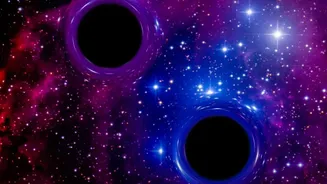
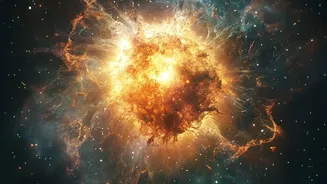
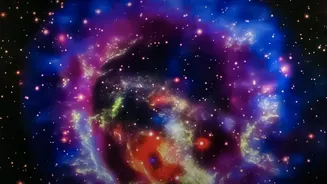
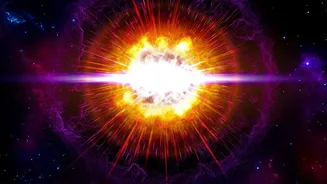
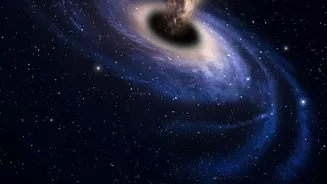
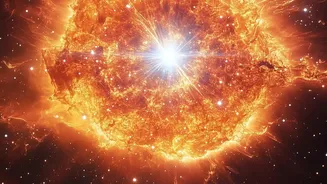
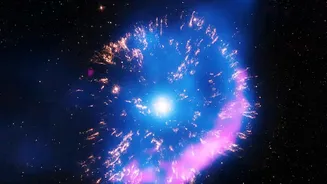
When a star many times more massive than our Sun runs out of fuel, its core collapses under its own immense gravity. This cataclysmic event can go one of two ways: a brilliant supernova explosion that leaves behind an ultra-dense neutron star, or a complete collapse into a black hole. For years, astrophysicists have used complex simulations to figure out what tips the scale. A crucial piece of the puzzle is that the collapsing core unleashes an unimaginable flood of neutrinos, which carry away about 99% of the explosion's energy. How these neutrinos behave in the seconds after the collapse appears to be the deciding factor.
A Surprising Flavor Change
Recent studies, including one from the University of Copenhagen, have revealed that a phenomenon called 'neutrino flavor conversion' may have a much larger impact than previously believed. This is where neutrinos switch between their different types. Scientists previously thought this behavior was a minor detail, but new simulations show it can dramatically alter the outcome. The research indicates that these flavor changes can affect how energy is transferred within the dying star, potentially robbing a budding supernova explosion of the power it needs to blast the star's outer layers into space.
More Black Holes, Fewer Supernovae?
The implications of this refined understanding are significant. According to the new models, including neutrino flavor conversion makes it more likely for many stars to fail to explode. Stars between 16 and 30 times the mass of the Sun, which were once thought to reliably produce supernovae, now appear more susceptible to collapsing directly into black holes when this neutrino behavior is factored in. This could help solve a long-standing astronomical mystery known as the 'supernova rate problem,' where scientists observe far fewer supernovae in the universe than theoretical models have predicted. The missing explosions may have been collapsing into black holes all along, guided by the subtle physics of neutrinos.
Refining Our Cosmic Map
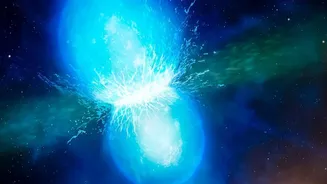
This research doesn't change what happens in the cosmos, but it dramatically sharpens our understanding of it. By incorporating more accurate neutrino physics, scientists can create more reliable models of stellar evolution. This helps them better interpret observations from gravitational wave detectors, which pick up the ripples in spacetime from events like black hole mergers, and neutrino observatories that wait patiently to catch these ghost particles from a nearby supernova. Every refinement brings us closer to a complete picture of how the universe builds its most extreme objects and distributes the elements necessary for life.
No Danger From a Distance
While talk of collapsing stars and black holes can sound alarming, it is important to note that this research is about fundamental understanding, not predicting any immediate threat to Earth. The cosmic events being studied occur light-years away. The findings help explain the fates of distant, massive stars and have no bearing on our own Sun, which is not massive enough to end its life in a supernova. The research offers a safer, more profound reward: a clearer window into the powerful forces that shape the universe, all driven by its most elusive particle.