

What is Greatest Evening Elongation?
In astronomy, elongation refers to the angle between the Sun and a planet as we see it from Earth. Because Venus orbits closer to the Sun than we do, it never appears to stray far from the Sun's glare. Its greatest elongation is the point in its orbit when
it reaches its maximum apparent distance from the Sun. When this happens in the evening sky, it's called the greatest eastern elongation. This event, happening on August 15, 2026, means Venus will be at its highest point above the horizon after sunset, making it visible for longer before it dips out of sight. It is the single best time to view the planet during its evening appearance.
The View on August 15, 2026
The peak of this celestial event occurs at 6:00 UTC on August 15, which is 11:30 AM Indian Standard Time. While the technical peak happens during India's daytime, the prime viewing window will be in the hours just after sunset on the evenings of August 14 and 15. On these nights, Venus will appear as a brilliant, unblinking beacon in the western sky. The planet will be shining at a dazzling magnitude of -4.4, making it easily the brightest object in the sky apart from the Moon. This is an ideal time for skywatching, as the planet will be far enough from the Sun's glare to be seen clearly in the deepening twilight.
How to Find Venus From India
Finding Venus is remarkably simple and requires no special equipment. Shortly after the sun disappears below the horizon, simply face west. You will see an intensely bright, star-like object that does not twinkle. That will be Venus. Throughout August, Venus will be situated in the constellation Virgo. On the evenings of August 14 and 15, the waxing crescent Moon will also be nearby, creating a beautiful pairing in the sky that will be hard to miss. For a precise view from your specific location in India, online tools like timeanddate.com or free planetarium apps like Stellarium can provide exact timings and sky charts.
What You Will See
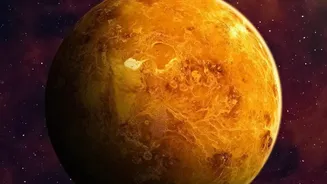
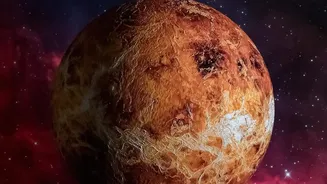
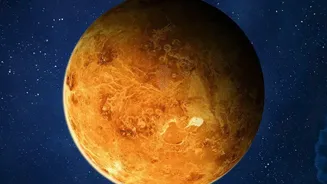
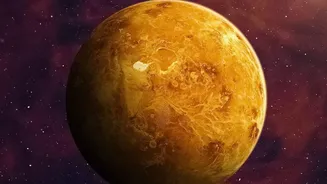
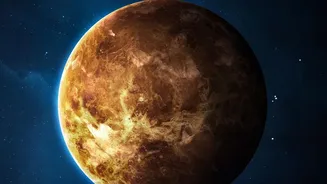
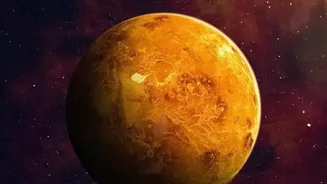
To the naked eye, Venus appears as a powerful, steady point of silvery-white light. Unlike stars, which twinkle due to atmospheric disturbance, Venus's light is a steady glow because it is a planet reflecting sunlight. If you have a pair of binoculars, you may be able to resolve Venus into a tiny disc rather than a point of light. A small telescope will provide an even more fascinating view. Around its greatest elongation, Venus appears about 50% illuminated, similar to a first-quarter Moon. This half-lit phase is a direct visual confirmation that you are observing another world in our solar system, with its own path around the Sun.
A Mid-August Celestial Treat
The greatest elongation of Venus is a regular and predictable event, but it remains a spectacular sight. It offers a perfect, low-effort opportunity for anyone to connect with the cosmos. It’s a wonderful activity for families, a romantic sight for couples, or a moment of quiet reflection for an individual. This August, the sky is putting on a show that requires nothing more than stepping outside after dinner and looking west. Don’t miss this chance to see our brilliant neighbour, the 'Evening Star', at its most convenient and captivating.