


Cosmic Misfits: What Are Brown Dwarfs?
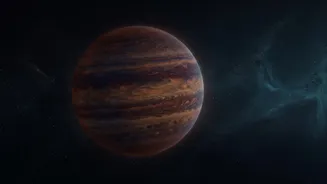
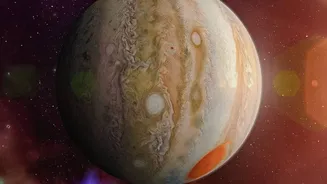
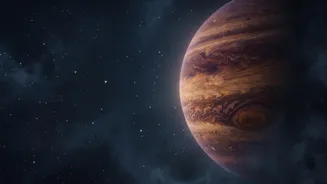
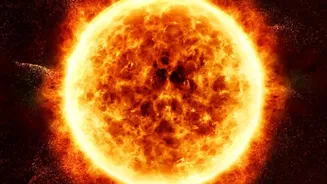
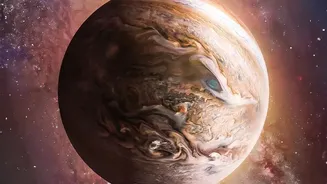
Imagine a star, a vast nuclear furnace like our Sun, powered by the fusion of hydrogen into helium. Now, imagine a planet, like Jupiter, a giant ball of gas without the internal fire of a star. Brown dwarfs live in the fascinating grey area between the two.
They are born from collapsing clouds of gas and dust, just like stars, but they never accumulate enough mass to kickstart sustained hydrogen fusion in their cores. This is why they are often nicknamed 'failed stars'. While they are not massive enough for starlight, they are hefty enough—typically 13 to 80 times the mass of Jupiter—to briefly fuse a heavier form of hydrogen called deuterium. This process generates some heat, but without a permanent engine, they cool down over their lifetime, glowing faintly in the infrared spectrum, which makes them prime targets for a telescope like the JWST.
The Old Assumption: A Uniform Family
For a long time, astronomers believed that brown dwarfs, while varied in temperature and age, might be relatively uniform in their basic atmospheric chemistry. The expectation was that their composition would follow predictable patterns based on their temperature, with certain molecules like water, methane, and ammonia appearing as they cooled. Models suggested that these objects, having formed from the same primordial clouds of gas, should share a similar chemical playbook. This assumption was built on decades of observations from ground-based telescopes and earlier space observatories like Spitzer and Hubble. While these instruments confirmed the existence of brown dwarfs and gave us initial glimpses into their nature, their view was limited. The real chemical intricacies remained hidden, waiting for a more powerful eye.
A New View from Webb: A Chemical Surprise
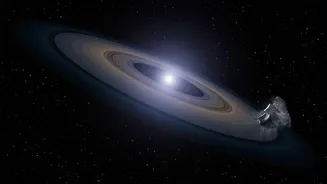
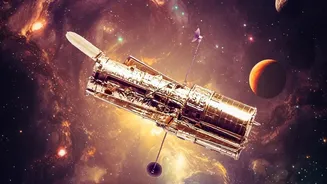
Enter the James Webb Space Telescope. With its unprecedented infrared sensitivity, JWST is peeling back the layers of these dim objects and finding a surprising chemical 'potpourri'. Recent observations, particularly of a star-forming region named IC 348, have revealed that brown dwarfs are far more chemically diverse than previously thought. One of the most stunning findings is the detection of an unidentified hydrocarbon—a molecule containing hydrogen and carbon—in the atmospheres of the coolest brown dwarfs. This chemical signature does not align with existing atmospheric models and suggests that complex chemical processes are at play. Adding to this, another recent study with Webb found a brown dwarf with the most chemically rich planet-forming disk ever seen around such an object, hinting that the raw ingredients for diverse planets could exist even around these 'failed stars'.
No Two Brown Dwarfs Are Alike
This newfound diversity challenges the idea of a one-size-fits-all model for brown dwarf atmospheres. One recent study noted that 'no two brown dwarfs are alike'. Scientists now believe this variation may stem from their formation history or unique atmospheric conditions. For instance, Webb’s observations have revealed brown dwarfs with clouds made of silicate particles—essentially, fine grains of sand or rock—swirling in their upper atmospheres. Other findings suggest the presence of molecules like methane and carbon dioxide in varying amounts. This diversity indicates that the line between a giant planet and a brown dwarf is becoming increasingly blurred. The chemical makeup of a brown dwarf's atmosphere might tell a story about where and how it was born, whether in a dense stellar nursery or in relative isolation.
Why This Cosmic Clue Matters
This discovery is more than just an astronomical curiosity; it rewrites a key chapter in our understanding of how both stars and planets form. By revealing that objects with masses just a few times that of Jupiter can form like stars, the Webb telescope is forcing scientists to rethink the lower limits of star formation. It shows that the universe can produce objects with planetary masses through the direct collapse of gas clouds. Furthermore, the unexpected chemical richness, including the presence of complex hydrocarbons and planet-forming disks, opens up fascinating possibilities. It suggests that the environments around these substellar objects could be capable of forming planets, potentially with very different chemical compositions than those in our own solar system. Studying the diverse chemistry of brown dwarfs provides a unique laboratory for understanding the atmospheric physics of giant exoplanets, which are often much harder to observe when orbiting a bright star.