




Imagine a city centre where the only sounds are footsteps, conversation, and music. Around the world, cities are reclaiming their streets for people. Here’s a look at six famous thoroughfares that prove life is often better without a car.
Strøget, Copenhagen, Denmark
As one of Europe's
longest pedestrian shopping areas, Strøget is a pioneering example of car-free urban design. When it was pedestrianised in 1962, many were sceptical, fearing it would kill business. Instead, it thrived. Today, this 1.1-kilometre network of streets is Copenhagen's vibrant heart, attracting around 80,000 people daily in the summer. The name itself means 'to stroll', and that’s exactly what you do here. The street links City Hall Square to the King's New Square, blending high-end retailers like Prada and Hermès with budget-friendly stores, historic buildings, and lively street performers. Strøget proved that prioritising people over traffic could create a socially and economically successful public space, inspiring cities worldwide.
The Shambles, York, England
Walking down The Shambles is like stepping into the Middle Ages. Considered one of the best-preserved medieval streets in the world, its origins trace back to the Domesday Book of 1086. The street is famous for its overhanging timber-framed buildings, some dating to the 14th century, which lean so closely together you can almost touch both sides at once. This architecture had a practical purpose: it sheltered the street below. Originally a street of butcher shops, its name derives from 'fleshammels', an old term for slaughterhouse. You can still see original meat-hooks on some storefronts. Today, the old butcher shops have been replaced by quaint boutiques, cafes, and shops inspired by wizarding worlds, making it a magical experience for any visitor.
La Rambla, Barcelona, Spain
More than just a street, La Rambla is a 1.2-kilometre-long celebration of public life. It features a wide, tree-lined central pedestrian promenade flanked by narrow service roads. It connects the bustling Plaça de Catalunya to the Christopher Columbus Monument at the port. The name comes from the Arabic word 'ramla', meaning 'sandy riverbed', as it was built on a former stream. La Rambla is a collection of smaller streets, which is why it's often called 'Las Ramblas'. Along your walk, you'll find flower kiosks, the famous La Boqueria market, the Liceu opera house, and a pavement mosaic by artist Joan Miró. It’s a stage for street performers, artists, and locals simply enjoying a stroll, embodying the vibrant spirit of Barcelona.
Rue Mouffetard, Paris, France
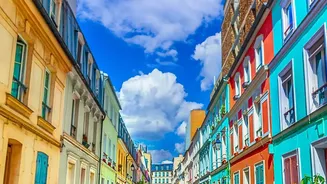
Nestled in the Latin Quarter, Rue Mouffetard is one of Paris's oldest and most charming market streets. Its history stretches back 2,000 years to a Roman road. Today, 'La Mouffe', as locals call it, is a bustling, narrow, cobbled street that feels like a village within the city. It famously escaped Baron Haussmann's grand 19th century redevelopment, preserving its medieval character. The lower part of the street transforms into a lively open air market, with shops selling cheese, pastries, fresh produce, and flowers. Described by Ernest Hemingway as a 'wonderful narrow crowded market street', it remains a place where Parisians do their daily shopping, offering an authentic taste of local life.
Cat Street,
Tokyo,
Japan
Connecting the vibrant districts of Shibuya and Harajuku,
Cat Street is Tokyo’s capital of cool.
Unlike the frenetic energy of nearby Takeshita Street or the Shibuya Scramble Crossing,
this pedestrian friendly lane offers a more relaxed,
curated atmosphere.
Officially named Kyu Shibuya gawa Yuhodoro ('Old Shibuya River Pedestrian Lane'),
it is the epicentre of Tokyo's youth fashion and streetwear scene.
The street is lined with a mix of independent boutiques,
international brands,
vintage stores,
and stylish cafes.
It's less about crowds and more about culture,
a place to discover emerging trends,
hunt for one of kind items,
and experience the city's cutting edge style at a walking pace.
Rua das Flores,
Curitiba,
Brazil
A true trailblazer,
Rua das Flores (Street of Flowers) in Curitiba became Brazil’s first major pedestrian street in 1972.
At a time when cities worldwide were designing themselves around the car,
Curitiba's mayor,
Jaime Lerner,
took a radical step.
The transformation was completed over a single weekend to avoid protests from shop owners who feared losing business.
When drivers threatened to reclaim the street,
Lerner reportedly had the city place paper on the ground for children to draw on,
creating a beloved public space overnight.
Today,
the street,
officially Rua XV de Novembro,
is a bustling commercial heart filled with historic buildings,
flower beds,
cafes,
and performers,
proving that people centric planning can be both bold and beautiful.