

The Sun’s Violent Storms
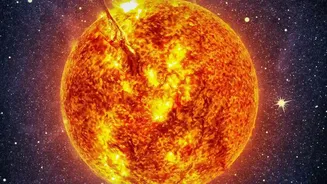
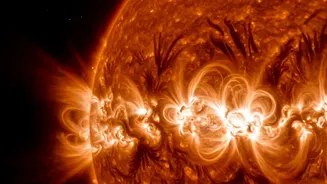
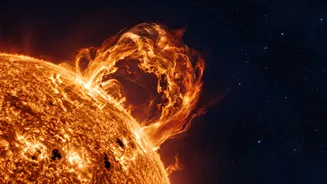
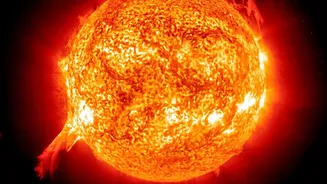
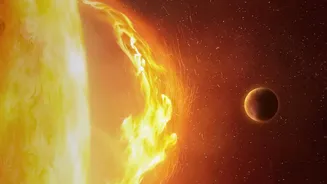
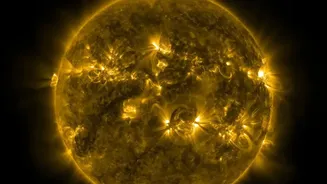
A Coronal Mass Ejection is one of the most dramatic events in our solar system. In these eruptions, the Sun flings vast quantities of magnetised plasma into space at immense speeds. While many miss our planet, those directed towards Earth can have serious
consequences. They can trigger powerful geomagnetic storms that disrupt our planet's magnetic field, potentially damaging satellites, knocking out power grids, and disrupting communication and navigation systems. One such event in 1989 caused a nine-hour blackout for millions in Canada. To protect our technologically dependent world, scientists need to understand these events better, and that means seeing them the moment they are born.
India’s Watchful Eye: Aditya-L1
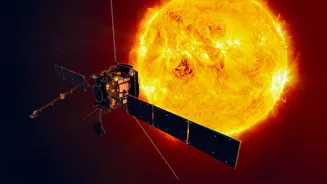
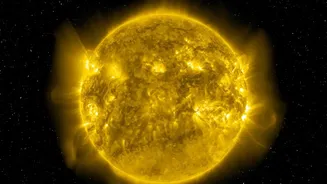
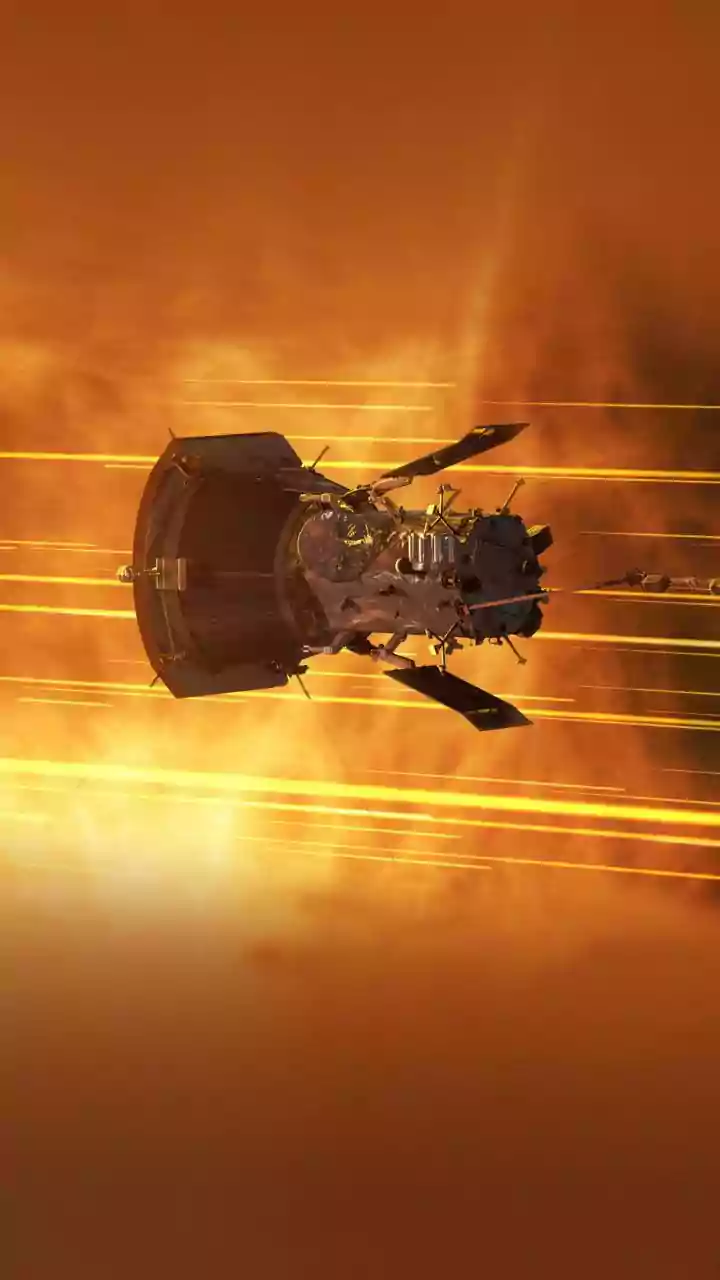
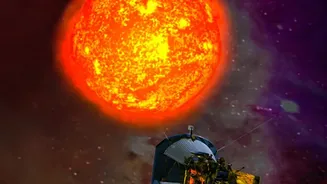
India's first dedicated solar mission, Aditya-L1, provides a crucial continuous watch on the Sun. Launched by ISRO on September 2, 2023, it orbits at Lagrange Point 1 (L1), a unique spot 1.5 million kilometres from Earth where it has an uninterrupted view of the Sun. One of its key instruments, the Visible Emission Line Coronagraph (VELC), is designed to study the solar corona, the Sun's incredibly hot outer atmosphere. By studying the corona's temperature, density, and velocity, VELC helps track the large-scale evolution of CMEs as they expand outwards from the Sun. Its spectroscopic capabilities allow scientists to understand the properties of the ejected material in great detail.
Europe’s Artificial Eclipse: Proba-3
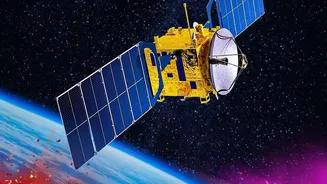
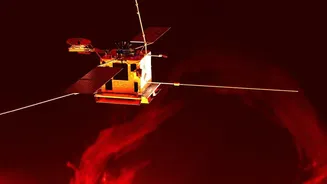
The European Space Agency's (ESA) Proba-3 mission, launched by an ISRO PSLV rocket in December 2024, is a feat of space engineering. It is the world's first precision formation-flying mission, consisting of two satellites flying in perfect tandem about 150 metres apart. One satellite, the 'Occulter', blocks the bright face of the Sun, allowing the second satellite's coronagraph, ASPIICS, to get a crystal-clear view of the extremely faint inner corona. This region is where CMEs are initiated, and observing it has been incredibly difficult until now. Proba-3 essentially creates a sustained, near-perfect artificial solar eclipse in space, revealing the Sun's secrets like never before.
A Synergy Revealing 'Early Changes'
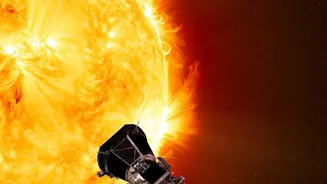
The power of this new research comes from combining the unique abilities of both missions. While Proba-3 provides an unprecedented close-up of a CME's birth in the inner corona, Aditya-L1's VELC offers a wider, continuous view, tracking the eruption as it grows. In a study published in 'Astronomy & Astrophysics', scientists from the Indian Institute of Astrophysics and their partners analysed two CMEs that occurred in September 2025. For the first time, they combined imaging data from Proba-3 with spectroscopic data from Aditya-L1 for the same events. This allowed them to cross-check measurements of the eruptions' mass, density, and energy right from their initial moments, revealing the subtle 'early changes' that were previously impossible to track.
Better Forecasts for Space Weather
Detecting the earliest signs of a CME is critical for improving space weather forecasting. Current warning systems can often provide only 15 to 60 minutes of advance notice before a CME's shockwave hits Earth's satellites. By understanding the physics of how a CME starts—how its energy is distributed between motion, heat, and magnetic fields—scientists can build more accurate prediction models. The joint observations from Aditya-L1 and Proba-3 provide precisely this fundamental information. Stronger, more reliable forecasts give satellite operators, power grid managers, and airlines more time to take protective measures, mitigating the worst impacts of a solar storm. This collaboration isn't just about advancing solar science; it's about making life on Earth safer.