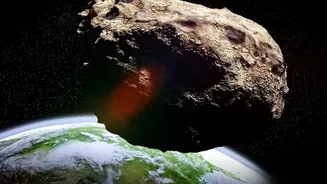






Successfully deflecting a hazardous asteroid is more complex than a simple cosmic billiards shot. A new study highlights a crucial factor: for lumpy, irregular space rocks, where you aim could make all the difference.
From Spheres to Spuds
For years, planetary defense models
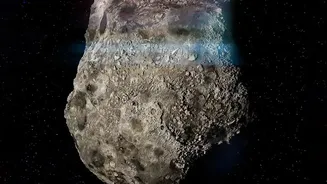
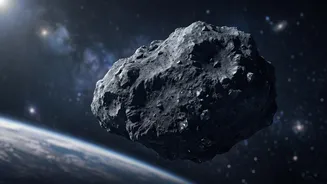
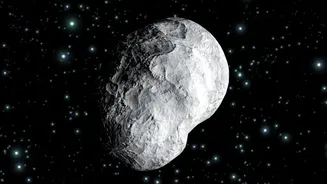
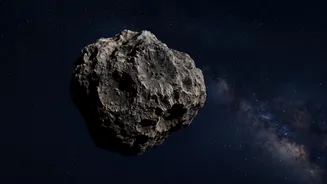
made a convenient, if inaccurate, simplification: they treated asteroids as perfect spheres. This made the incredibly complex math of a high-speed impact manageable. The only problem, as Sandia National Laboratories physicist Nathan Moore noted, is that 'spherical asteroids don't exist'. Real asteroids are lumpy, uneven, and irregularly shaped, more like potatoes than marbles. A new set of simulations from Sandia has moved beyond this simplification, incorporating realistic 3D asteroid shapes based on spacecraft flyby imagery. By doing so, they have uncovered a startling reality about what it would take to nudge a threatening space rock off its course.
A Fivefold Difference
The research, published in the journal Icarus, examined how X-rays from a nearby nuclear detonation—one of the leading concepts for deflecting very large asteroids—would affect an asteroid's trajectory. The results were dramatic. In one simulation, targeting one side of an irregular asteroid produced a change in velocity of 3.9 millimeters per second. However, when the simulated blast was aimed at a different side of the exact same asteroid, the change was just 0.8 millimeters per second. That is a nearly fivefold difference in effectiveness, based solely on the aimpoint. 'We expected aim to matter', Moore said. 'What surprised us was how much'. The study also found that the change in the asteroid's spin could vary by a factor of 17 depending on the target location.
Why Aim Is Everything
The massive difference in effect comes down to an asteroid's uneven topography. The proposed nuclear deflection method doesn't rely on a direct impact. Instead, a nuclear device would detonate at a distance, bathing one side of the asteroid in powerful X-rays. This intense energy instantly vaporizes the surface material, which shoots off into space, creating a powerful push—like a rocket engine—that nudges the asteroid. An irregular surface with ridges, slopes, and hollows complicates this process immensely. A blast directed at a concave or hollowed-out area might trap some of the vaporized material, dampening the push. A blast hitting a prominent ridge could be far more effective. The Sandia simulations model how this escaping material changes both the asteroid's forward motion and its rotation.
Smarter Defense for the Future
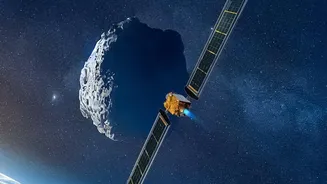
These findings have profound implications for future planetary defense strategies. They show that simply sending a deflector to an asteroid isn't enough. Missions like NASA's successful DART (Double Asteroid Redirection Test) in 2022 proved the 'kinetic impactor' concept of hitting an asteroid to change its path. However, even that mission's success, which altered its target's orbit more than predicted, highlighted how much we still need to learn about an asteroid's composition and structure before we hit it. The Sandia study reinforces this lesson. Any future mission, whether a kinetic impactor or a nuclear device, would first require detailed reconnaissance to map the asteroid's shape and composition. This would allow mission planners to run simulations, much like Sandia's, to find the optimal point of impact to ensure the asteroid is deflected without accidentally shattering it into multiple new threats. 'Pick the right side and you win. Guess wrong and it could be a bad day', Moore warned.