



A Prime Suspect for Habitability
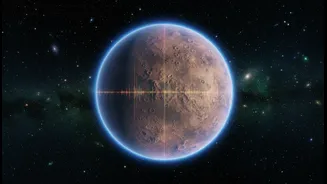
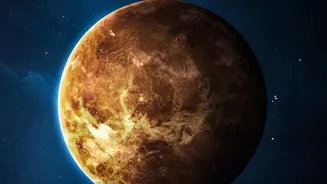
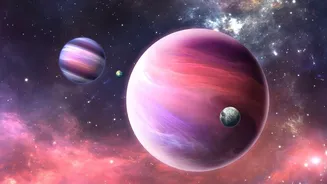
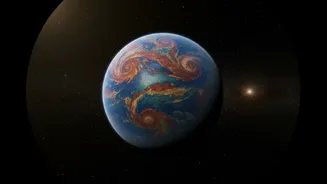
Located about 49 light-years away, LHS 1140 b has been a tantalizing target for astronomers since its discovery in 2017. It's what's known as a 'super-Earth'—a rocky world that is larger and more massive than our own planet, clocking in at about 1.7 times
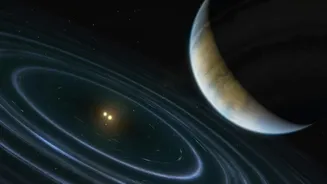
Earth's radius and 5.6 times its mass. Crucially, it orbits within the 'habitable zone' of its star. This is the so-called 'Goldilocks' region, where conditions are neither too hot nor too cold, but just right for liquid water to potentially exist on the surface, a key ingredient for life as we know it. The planet orbits a red dwarf star, which is smaller and cooler than our sun.
How to See an Invisible Atmosphere
Detecting an atmosphere 49 light-years away is a monumental challenge. Scientists accomplished this feat using a technique called transmission spectroscopy. As LHS 1140 b passes in front of its host star, a tiny fraction of the starlight filters through the planet's atmosphere. Powerful instruments, including those on the James Webb Space Telescope (JWST), can analyze this light. Different gases in an atmosphere absorb light at specific wavelengths, leaving a unique chemical fingerprint. The breakthrough came from detecting helium escaping from the planet’s upper atmosphere. While helium itself doesn't support life, its presence is clear evidence that an atmosphere exists to begin with.
An Atmosphere Confirmed, But What's In It?
This is where the story gets even more interesting. The initial detection confirms there is a gaseous envelope, which is a massive milestone. Previous observations had ruled out a thin, hydrogen-dominated atmosphere, suggesting something more substantial was present. The new data strongly supports a thicker, higher mean molecular weight atmosphere, which could be composed of gases like nitrogen, carbon dioxide, and, yes, water vapor. However, confirming the presence of the atmosphere is a separate, earlier step than identifying its detailed composition. It's like knowing a house is there before you can see what furniture is inside. This makes LHS 1140 b the first rocky planet in a habitable zone to have its atmosphere confirmed in this way.
The Next Frontier: The Hunt for Water
The confirmation of an atmosphere immediately makes LHS 1140 b a top-priority target for further study with the JWST. The next goal is to parse those atmospheric fingerprints in much greater detail to find out exactly what it's made of. The ultimate prize would be the detection of significant water vapor. Finding water would elevate the planet from being merely 'potentially habitable' to being a world with one of the most critical known components for life. Some models based on the planet's density even suggest it could be an 'ocean world', with a significant fraction of its mass being water. While this is still speculation, the tools are now in place to begin answering these questions. Scientists will continue to point their best telescopes at this system, patiently gathering the light that will reveal the secrets of this distant world.