



A Gift That Keeps on Giving
The New Horizons mission in July 2015 was a landmark moment in planetary exploration. For the first time, humanity got an up-close look at the distant, icy world of Pluto. Instead of a dead, crater-pocked ball of ice, the spacecraft revealed a world that
was surprisingly dynamic, with vast nitrogen glaciers, towering water-ice mountains, and a hazy blue atmosphere. The data collected in just a few hours of the flyby was so immense it took over a year to transmit back to Earth, and scientists have been poring over it ever since. This latest discovery is a testament to the mission's enduring value, showing how fresh analysis and new modeling techniques can unlock secrets hidden in plain sight.
The Secrets of a Frozen Heart
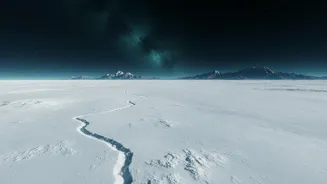
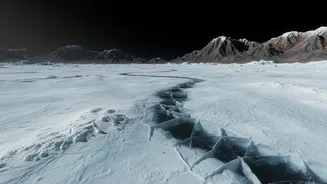
The finding centers on Sputnik Planitia, the western lobe of Pluto's famous heart-shaped feature. This enormous basin is filled with frozen nitrogen and is larger than Texas and Oklahoma combined. Initial images from 2015 showed strange, city-sized convection cells and dark linear features, hinting at geological activity. A new study, published in The Planetary Science Journal, takes a closer look at these dark streaks. Researchers noticed the patterns strongly resemble features on Earth's own glaciers that have been wetted by liquid.
Finding Liquid Where It Shouldn't Exist
The puzzle for scientists was how liquid could exist on a world where surface temperatures hover near minus 230 degrees Celsius. Pluto's thin atmosphere makes liquid nitrogen rain physically impossible. The new research proposes a fascinating alternative: the liquid is coming from below. Scientists believe that pressure at the base of the kilometers-deep nitrogen glacier could be sufficient to cause some of the ice to melt. This liquid nitrogen, being buoyant, is then forced upwards through cracks and fractures in the ice sheet, much like lava through geyser tubes. Upon reaching the frigid surface, it can remain liquid just long enough to flow and wet the surface, creating the dark patches observed by New Horizons before it freezes again.
A World More Alive Than Imagined
This is the first direct evidence suggesting liquids have recently flowed on Pluto's surface. The term "recent" here is on an astronomical scale; the surface of Sputnik Planitia is thought to be less than a million years old. The finding reinforces the view that Pluto is not a static, geologically dead world. Instead, it is a complex and active body, even billions of kilometers from the Sun's warmth. Alan Stern, the principal investigator for the New Horizons mission and lead author of the study, noted that "Pluto never stops surprising us." He explained that the discovery suggests not just recent liquid flows but also a new kind of time-variable feature on the dwarf planet, hinting that its surface may still be changing today.
The Ongoing Journey of Discovery
The re-analysis of the New Horizons data shows how valuable long-term study of mission archives can be. By comparing the Pluto images to modern satellite imagery of Earth's own ice sheets and using advanced computer models, scientists were able to develop a new hypothesis for a feature they first saw years ago. This process of questioning, modeling, and re-examining data is central to scientific progress. While New Horizons has long since left Pluto behind and is now exploring the outer reaches of the Kuiper Belt, its brief encounter continues to reshape our understanding of the icy worlds at the edge of our solar system.