







Power and Artistry in One
In India, a fort was never just a military outpost; it was the heart of a kingdom, a symbol of the ruler's authority, and a centre for administration, culture, and art. This philosophy is etched in stone across the subcontinent. The architecture was a deliberate
statement: the colossal, often brutalist walls were designed to intimidate enemies and project an image of unshakeable power, while the delicate, intricate palaces within showcased the ruler's wealth, taste, and the flourishing of culture under their reign. This duality wasn't a contradiction but a complete expression of kingship, where the capacity for war and the patronage of beauty were two sides of the same coin. These structures were often living cities, housing not just the royal family but also nobles, soldiers, artisans, and entire urban settlements.
Mehrangarh Fort, Jodhpur
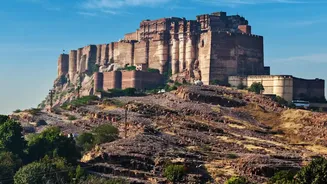
Rising from a 400-foot rocky hill, Mehrangarh Fort in Jodhpur appears to be an extension of the earth itself, a colossal structure of red sandstone. Its walls, some reaching 120 feet high, are a masterclass in defensive architecture, built to withstand cannon fire and prolonged sieges. But once you pass through its seven imposing gates, the grim reality of war gives way to a world of stunning refinement. The fort contains a series of palaces with names that evoke poetry, like the Phool Mahal (Flower Palace) and the Moti Mahal (Pearl Palace). These courtyards and halls feature impossibly delicate latticed stone windows (jalis), intricate carvings, and interiors that once gleamed with gold filigree and mirrors, revealing a life of immense luxury and artistic appreciation hidden within the fortress.
Amber Fort, Jaipur
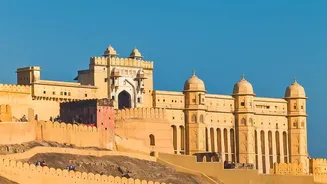
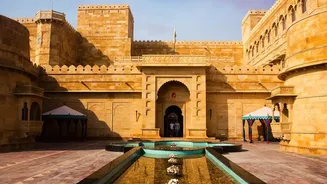
Overlooking Maota Lake, the honey-hued Amber Fort is more palace than fortress at first glance, but its strategic position and fortified passages reveal its military purpose. It is a perfect blend of Rajput and Mughal architectural styles. Visitors ascend past formidable walls to enter a series of four courtyards that become progressively more private and lavish. The journey moves from the Diwan-i-Aam (Hall of Public Audience) to the inner sanctums of royal life. The fort's crown jewel is the Sheesh Mahal, or Mirror Palace. Here, the walls and ceilings are inlaid with thousands of tiny mirror pieces. It is said that a single candle flame can illuminate the entire hall, creating the illusion of a starry sky for the queen who was forbidden from sleeping in the open. It is a breathtaking example of creating a magical, private world within a secure fortress.
Red Fort, Delhi
Built by Mughal Emperor Shah Jahan, the Lal Qila or Red Fort was the main residence of the emperors for nearly 200 years. Its massive enclosing walls of red sandstone, standing up to 33 metres high, were built to protect the imperial capital. Within these walls, however, lay a paradise. The complex included stunning palaces, such as the Diwan-i-Khas (Hall of Private Audience), a pavilion of white marble inlaid with precious stones. A famous Persian couplet inscribed here reads, "If there be a paradise on Earth, it is this, it is this, it is this." An intricate water channel, known as the Nahr-i-Bihisht (Stream of Paradise), flowed through the centre of these palaces, cooling the apartments and connecting the various buildings in a geometrically perfect layout that was designed for both imperial ceremony and private luxury.
Jaisalmer Fort, Jaisalmer
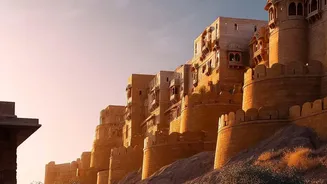
Jaisalmer Fort, known as Sonar Quila or the Golden Fort, rises from the Thar Desert like a sandcastle from a storybook. What makes it unique is that it is one of the few "living forts" in the world, with nearly a quarter of the old city's population still residing within its walls. Built in 1156, its massive yellow sandstone walls appear golden in the sunlight. Inside this defensive exterior is a labyrinth of narrow lanes, havelis (mansions), temples, and shops. The fort demonstrates how an entire community, not just a king, could thrive within fortified walls. The intricate architecture of the havelis, with their carved balconies and windows, shows that even the merchants and residents of the city participated in this culture of creating beauty and comfortable living spaces within a structure designed for defence.