








A Groundbreaking Look Beneath the Dust
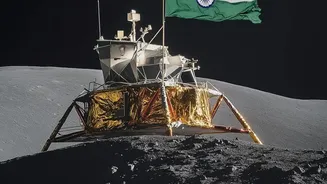
Scientists from Ahmedabad's prestigious Physical Research Laboratory (PRL), working closely with ISRO, have revealed fascinating new insights into the thermal properties of the Moon's soil, known as regolith. Using data from the Chandrayaan-3 lander's
ChaSTE (Chandra’s Surface Thermophysical Experiment) payload, they have generated the first-ever in-situ temperature profile of the lunar topsoil around the south pole. The experiment involved a probe that successfully penetrated about 10 centimetres into the ground, equipped with ten individual temperature sensors. The findings were startling: the probe recorded a massive temperature difference of 50 to 80 degrees Celsius between the surface and a depth of just a few centimetres. This confirmed that the lunar topsoil is an incredibly effective insulator, a poor conductor that prevents heat from the sun from penetrating deep into the subsurface.
India's ChaSTE Delivers Unique Data
The ChaSTE instrument, developed jointly by PRL and ISRO's Space Physics Laboratory, provided a unique dataset that missions have sought for decades. While past missions, like the Apollo program, conducted heat flow experiments, they were near the lunar equator. ChaSTE's measurements from Chandrayaan-3's high-latitude landing site (around 69°S) are crucial for a different reason: understanding the conditions that might allow for the presence of water ice. The instrument's success was also a significant engineering achievement. Its probe used a controlled, rotating mechanism to push into the soil, succeeding where previous missions with hammering devices had failed. This allowed for pristine temperature measurements that are now helping scientists model exactly how the Sun's heat travels down from the lunar surface.
More Than Just Dust and Rock
The analysis from PRL scientists suggests the lunar surface is far from uniform. Their findings indicate a layered, cake-like structure in the top few centimetres of the regolith. The very top layer is described as a 'fluff' layer, which is highly porous and acts like a thermal blanket. Just a few centimetres deeper, the soil becomes surprisingly cohesive, or sticky, and its density increases significantly. This layered structure has profound implications. For one, the insulating top layer is crucial for the potential storage of water-ice molecules in the subsurface, protecting them from the sun. The data also showed that local terrain plays a huge role. Sun-facing slopes can be considerably warmer, while a pole-facing slope just a metre away could be cold enough to harbour ice near the surface. In fact, the research suggests that high-latitude areas with slopes greater than 14 degrees facing away from the sun might offer an environment similar to the permanently shadowed polar craters for accumulating water ice.
Informing the Next Wave of Exploration
These discoveries are not just academic; they have direct, practical applications for the future of lunar exploration. As agencies like NASA and ISRO plan for crewed landings and long-term habitats, understanding the mechanical and thermal properties of the regolith is critical. The extreme temperature swings on the Moon, from over 120°C in daylight to below -200°C at night, pose a massive challenge for equipment and astronauts. The cohesive nature of the subsurface soil could affect rover traction and the stability of landed structures. Furthermore, knowing exactly how temperature varies with depth and local slope is essential for selecting future landing sites, especially for missions aiming to prospect for resources like water ice. The data from ChaSTE provides ground-truth information that is far more accurate than what can be inferred from orbiters, helping to refine the models used for planning these complex and expensive missions.