






The Universe's Power Beams
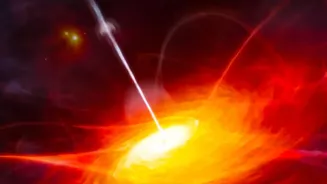
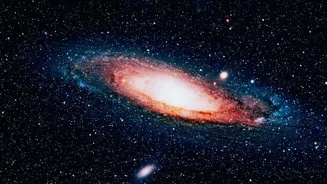
To understand a microblazar, you first have to meet its much larger relative: the blazar. At the heart of some distant galaxies, supermassive black holes, millions or even billions of times the mass of our Sun, are furiously consuming stars, gas, and dust.
This cosmic feast creates a swirling, superheated disk of material around the black hole. While much of this material is doomed, some is channeled by intense magnetic fields into two colossal jets of particles, which are blasted away from the black hole's poles at nearly the speed of light. When one of these incredibly powerful jets happens to be pointed directly at Earth, we call the object a blazar. This direct line of sight makes them appear exceptionally bright and energetic from our perspective.
Searching for a Miniature Version
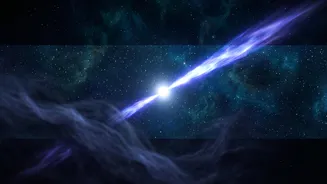
For years, scientists have theorized that a smaller version of this phenomenon should exist. Instead of a supermassive black hole, a microblazar would be powered by a stellar-mass black hole, just a few dozen times the mass of our Sun. These smaller black holes would be part of a binary system, siphoning material from a companion star. This stolen material would form a similar jet of high-energy particles. If that jet were aimed at Earth, we would see a microblazar. The challenge is that these objects have been incredibly elusive. While astronomers have found 'microquasars'—where the jets are not pointed at us—a true microblazar, with its jet staring us down, had never been confidently identified until now.
The Prime Candidate: IRAS 18293-0941
An international team of researchers has identified what they call the strongest candidate yet for a microblazar. The object, named IRAS 18293-0941, is located about 12,000 light-years away within our own Milky Way galaxy. It is a binary system where a black hole, estimated to be about 10 times the Sun's mass, orbits a large companion star every 11 days, pulling material from it. Using a combination of telescopes, including radio and gamma-ray observatories, scientists detected powerful emissions and a jet of particles traveling at around 75% the speed of light. Crucially, evidence suggests this jet is aimed almost directly at Earth, fulfilling the primary requirement for a microblazar.
Why Scientists Remain Cautious
Despite the compelling evidence, the scientific community is careful to label IRAS 18293-0941 as a 'candidate' for now. One of the theoretical hallmarks of a microblazar is rapid and dramatic fluctuation in brightness, something that hasn't been strongly observed in this object yet. Further observations are needed to confirm the jet's precise orientation and study its behavior over time. This process of rigorous verification is standard in science; an extraordinary claim requires extraordinary evidence. Confirming the discovery will involve more detailed analysis from multiple telescopes to ensure the object's characteristics fully align with theoretical models of microblazars.
A Cosmic Laboratory in Our Backyard
If confirmed, this discovery would be hugely significant. Because blazars are in distant galaxies, they are difficult to study in detail. A microblazar in our own galaxy would act as a local laboratory for understanding how black holes—both large and small—form these incredible jets. It would offer a close-up view of the physics behind some of the most powerful particle accelerators in the universe. The jet from IRAS 18293-0941 appears to be slamming into a nearby cloud of interstellar gas, accelerating particles to energies far greater than anything achievable on Earth. Studying this interaction could help solve long-standing mysteries about the origin of ultra-high-energy cosmic rays that constantly bombard our planet.