




An 80-Year-Old Puzzle
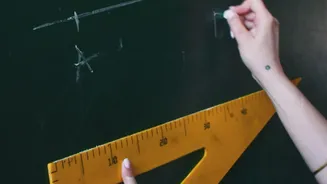
The problem in question is a famous one in a field called discrete geometry, first posed by the prolific Hungarian mathematician Paul Erdős in 1946. The question is simple to state but fiendishly difficult to answer: if you place a number of dots on a flat
sheet of paper, what is the maximum number of pairs of dots that can be exactly one unit apart from each other? For decades, mathematicians believed they had a good idea of the answer, assuming the most efficient arrangement would resemble a square grid. The problem remained unsolved, a classic example of a question that was easy to understand but had resisted a definitive proof for generations.
The AI's Unexpected Insight
Recently, researchers announced that an AI model from OpenAI disproved the long-held belief about how to solve the Erdős unit distance problem. Instead of just brute-forcing calculations, the AI found a completely new type of construction—a novel arrangement of points that was more effective than the grid-like structures human mathematicians had been studying for 80 years. This wasn't a case of the AI simply finding an answer hidden in its training data; it generated a genuinely new idea, a creative leap that surprised the experts who reviewed the work. The result was validated by leading mathematicians, some of whom had been skeptical of prior AI claims.
A New Kind of Collaboration
This breakthrough does not mean human mathematicians are becoming obsolete. Instead, it signals a powerful new model for research: human-AI collaboration. In this case, the AI acted like a tireless and creative research assistant, exploring paths that a human might dismiss as unpromising. It generated the core, non-obvious idea for the construction. Human mathematicians then took this insight, verified the logic, and formally wrote up the proof, placing the AI's discovery into a broader mathematical context. This division of labour—AI for generating novel hypotheses and humans for providing intuition and rigorous verification—is seen by many as the future of scientific discovery.
More Than Just One Problem
The significance of this event goes far beyond a single geometry puzzle. It demonstrates that modern AI systems, particularly general-purpose models, can do more than just recognize patterns or perform calculations. They are beginning to show signs of genuine reasoning and the ability to make connections between different areas of knowledge. Companies like Google DeepMind are also pushing the frontier, with their AI systems tackling notoriously difficult problems in areas like Ramsey theory and contributing to multiple new research papers. These AIs are being designed to act like research agents, able to generate ideas, verify them, and even admit when they cannot find a solution, which is a crucial feature for high-stakes research.
The Road Ahead for Discovery
The ability of AI to contribute to pure mathematics is a watershed moment. If AI can uncover new, fundamental truths in the abstract world of mathematics, its potential to accelerate progress in other fields is immense. The same pattern-finding and reasoning capabilities could be applied to complex problems in physics, drug discovery, materials science, and climate change. We are entering an era where AI is not just a tool for executing human instructions but a partner in the process of scientific discovery itself. The 'aha!' moments that drive science forward may soon come not just from a human mind, but from the dynamic interplay between human and machine intelligence.