






A Landmark Lunar Connection
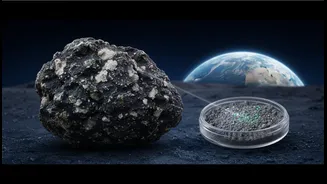
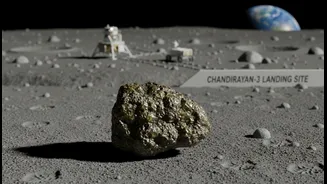
Scientists from the Physical Research Laboratory in Ahmedabad have revealed that soil analysed by the Pragyan rover at its landing site, Shiv Shakti Statio, has a chemical composition that closely resembles a very special rock on Earth. That rock is ALHA
81005, a meteorite discovered in Antarctica in 1982 that holds the distinction of being the first meteorite ever confirmed to have originated from the Moon. This breakthrough finding creates a direct bridge between in-situ measurements on the lunar surface and physical samples studied in labs on Earth, opening new windows into the Moon's ancient past.
The Rare Chemical Match
The Pragyan rover used its Alpha Particle X-ray Spectrometer (APXS) to determine the elemental makeup of the soil at the lunar south pole. The data showed the soil had lower-than-usual levels of aluminium oxide and significantly higher levels of iron and magnesium oxides compared to typical lunar highlands. When scientists compared this unique signature to the profiles of 66 known lunar meteorites, ALHA 81005 was the closest match. Both the landing site soil and the meteorite occupy a rare compositional space between two major groups of lunar rocks, known as ferroan anorthosites and Mg-suite rocks, making their similarity highly significant.
Pragyan's Detective Work
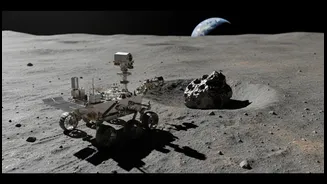
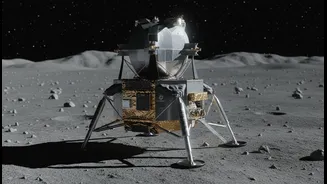
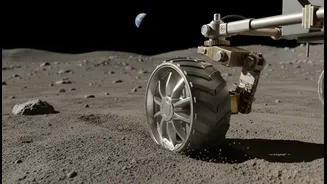
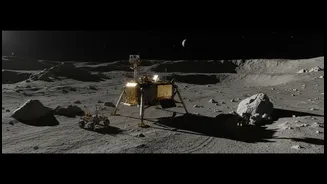
The Chandrayaan-3 mission made India the first nation to successfully land a spacecraft near the lunar south pole in August 2023. After landing, the Vikram lander deployed the six-wheeled Pragyan rover, which traversed over 100 meters of the lunar surface. Along its journey, it used its suite of instruments, including the APXS and a Laser-Induced Breakdown Spectroscope (LIBS), to perform the first-ever on-site chemical analysis of the south pole region. While earlier findings from the mission confirmed the presence of sulphur and other elements, this new analysis connecting the soil to a specific meteorite showcases the long-term scientific value of the mission's data.
Clues to a Violent Past
ISRO has clarified that the chemical match does not mean the meteorite came from the exact spot where the rover landed. Instead, it suggests both the Shiv Shakti site and the region where the meteorite was formed represent a similar type of magnesium-rich lunar crust. Scientists believe the unique composition at the landing site could be the result of a massive impact billions of years ago. The South Pole-Aitken basin, one of the largest impact craters in the solar system, is nearby. The cataclysmic event that formed it could have excavated material from deep within the Moon's mantle and scattered it across the surface, including at the Chandrayaan-3 landing site.
Rewriting Lunar History
This discovery does more than just link a landing site to a meteorite; it helps refine our understanding of the Moon's formation. The findings support the Lunar Magma Ocean hypothesis, a leading theory that the Moon was once covered by a vast ocean of molten rock. The presence of what appears to be a mix of upper crust and deeper, magnesium-rich mantle material helps scientists piece together how that magma ocean cooled and solidified to form the Moon we see today. By establishing a direct link between rover data and meteorite samples, researchers can be more confident in their models of lunar evolution.
A Triumph for Indian Science
The continued stream of discoveries from Chandrayaan-3 solidifies its status as a landmark scientific mission, not just a landing triumph. It demonstrates ISRO's capability to not only execute complex interplanetary missions but also to generate world-class scientific data that contributes significantly to global planetary science. This success strengthens the case for future investment in India's space program and cements its reputation as a major player in planetary exploration. The data gathered during Pragyan's short mission will continue to be analysed for years, promising even more insights into the secrets of our nearest celestial neighbour.