




A Symphony of Chaos
On a typical American highway, a Tesla's screen is a picture of order. It shows neat lanes, predictable cars, and the occasional pedestrian. In India, it’s a different world. Recent viral clips, including one from Gurugram that amassed over 12 million
views, show the screen flickering with dozens of objects simultaneously. Cars, motorcycles, auto-rickshaws, pedestrians, and sometimes even animals are all detected in extremely close proximity, weaving and jostling for space. The system, which uses cameras for its 'Tesla Vision', tries to render it all in real-time. What emerges is a digital reflection of the controlled chaos on the ground: a jumble of icons that perfectly illustrates the gap between a Silicon Valley algorithm and the desi reality check of an Indian street. The system appears particularly perplexed by auto-rickshaws, struggling to classify the three-wheeled vehicles that are a backbone of Indian urban transport.
The Unwritten Rules of the Road
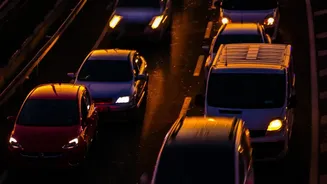
To an outsider, Indian traffic can seem lawless, but it operates on a complex, unwritten system of negotiation. It is a heterogeneous mix where bicycles, auto-rickshaws, buses, and luxury cars share the same space. Lane markings, where they exist, are often treated as suggestions rather than rules. Drivers use subtle cues, constant adjustments, and a language of honks to communicate intent and claim space. This fluid, high-density environment is the opposite of the structured, rule-based system that self-driving software is trained on. The AI is programmed for a world of predictable behaviour and clear infrastructure, not one where a cow might wander into traffic or a motorcyclist will materialize in the sliver of space between two cars. These aren't 'edge cases' in India; they are everyday occurrences.
A 'Brain Migraine' for the AI
The problem isn’t necessarily that the Tesla can’t see the objects. In fact, the crowded screen proves its vision system is detecting a huge amount of data. The real challenge lies in prediction and decision-making. As one social media user joked, the car is having a “brain migraine”. Autonomous systems rely on massive datasets to train their neural networks to predict what other objects on the road will do next. Most of this training data comes from North America and Europe, where traffic is comparatively orderly. When faced with the sheer density and unpredictable movements on an Indian road, the AI’s predictive models are pushed to their limits. It struggles to anticipate whether the auto-rickshaw will swerve, the pedestrian will cross, or the biker will cut in, because its training library has few comparable examples.
More Than Just a Software Update
Fixing this is not a simple matter of a quick software patch. It represents a fundamental challenge for the global ambitions of autonomous vehicle makers. For a system like Tesla's to work reliably in India, it would need to be retrained on millions, if not billions, of kilometres of local driving data. This would allow the AI to learn the local driving 'dialect'—the nuances of how people navigate crowded spaces, the meaning of a particular honk, and the expected behaviour of a diverse range of vehicles. This is a monumental and expensive task. It requires not just collecting data but also correctly labelling it and using it to build entirely new behavioural models. Without this deep localisation, deploying fully autonomous features remains a distant and potentially dangerous prospect.
The Road Ahead in India
The viral videos have sparked a broader conversation about the future of self-driving in India. While the government has expressed skepticism about fully driverless cars, citing potential job losses, the focus is shifting towards Advanced Driver-Assistance Systems (ADAS). These systems, which help with functions like emergency braking and lane-keeping assistance, can be adapted more easily to local conditions. The chaotic Tesla screen serves as a powerful reminder that technology is not a one-size-fits-all solution. For any company hoping to succeed, the path to autonomy on Indian roads requires more than just smart code; it demands a deep understanding of the human and cultural context in which it operates. India may prove to be the ultimate test for any AI that claims it can truly drive.