





The Ultimate Off-Grid Patient
As humanity sets its sights on returning to the Moon and eventually landing on Mars, one of the biggest hurdles isn't just propulsion or habitat design—it's medicine. A mission to Mars could take years, and with communication delays of up to 20 minutes
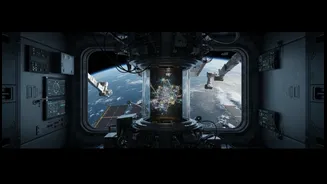
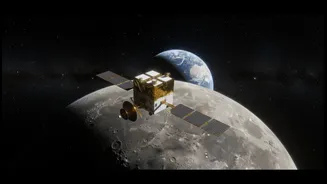
each way, a real-time video call with a doctor is impossible. Astronauts must become their own first responders, equipped to handle everything from bone fractures to sudden illnesses without the possibility of a quick evacuation. The International Space Station (ISS) serves as a crucial testbed for the technologies needed to bridge this gap, allowing researchers to see what works in a microgravity environment before entrusting a crew's life to it millions of kilometres from home.
A Doctor in a Box
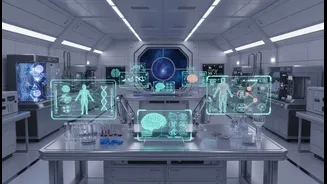
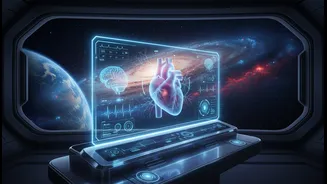
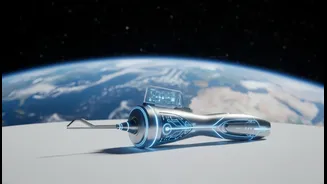
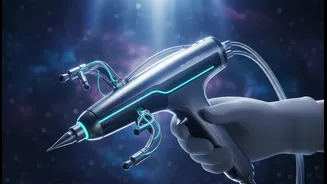
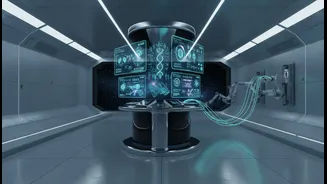
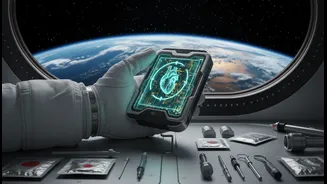
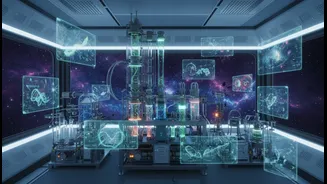
The latest suite of medical gear being tested aboard the ISS is designed to give astronauts powerful diagnostic capabilities that were once the exclusive domain of hospitals. Recent experiments include the EchoFinder-2, an ultrasound device from the European Space Agency (ESA) that uses augmented reality and AI to guide non-medically trained astronauts to perform complex scans. The augmented reality interface shows the operator exactly where to place the probe, and an AI then helps identify organs and capture clear images. Another key technology is portable DNA sequencing to understand how bacteria might become resistant to antibiotics in space, which is critical for treating infections. Recently, astronauts also successfully tested a portable X-ray machine in orbit for the first time, a major step beyond the long-used ultrasound technology.
AI and Augmented Reality Assistants
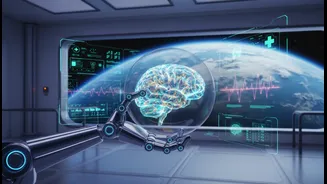
Beyond just hardware, AI-powered assistants are becoming vital crewmates. One such system, CIMON (Crew Interactive Mobile Companion), is a free-floating AI robot that acts as a hands-free database and assistant. An astronaut can ask CIMON to display procedures for an experiment, leaving their hands free to work. This technology is being expanded for medical purposes. For instance, the EchoFinder ultrasound uses AI to interpret images, a task that would normally require a trained radiologist. Similarly, researchers are developing wearable biosensors that use AI analytics to monitor vital signs like heart rate and oxygen saturation, alerting the crew to health issues before they become critical. These systems are designed to make complex medical tasks manageable for a small, non-specialist crew.
From the ISS to Remote India
While designed for the rigors of space, these medical innovations have profound implications for healthcare on Earth. Technologies like remote-guided ultrasound and portable diagnostic tools could revolutionise medical access in remote villages, on ships at sea, or in disaster zones where specialists are scarce. The same tele-diagnosis systems that connect an astronaut to a doctor on Earth could connect a rural health worker to a specialist in a major city. For example, the Tempus Pro, a portable monitor developed for ESA to track astronaut vitals, is now used in aircraft and conflict areas. The push for lightweight, durable, and easy-to-use medical devices for space is accelerating the development of next-generation telemedicine for everyone.