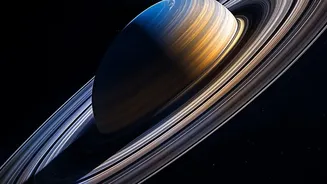





When you picture the planet Saturn, you inevitably see its breathtaking rings. They are the planet’s most famous feature, but they are not solid bands. Instead, they are a colossal, orbiting collection of countless pieces of ice, rock, and dust.
A River of Ice and Rock
At its
heart, the headline is entirely correct. Saturn's rings are overwhelmingly composed of water ice, making up about 99.9% of their mass. The remaining fraction is a mix of rocky material and dust, likely from micrometeoroids that have crashed into the ring system over millions of years. These particles orbit Saturn in a flat, expansive disk that stretches up to 282,000 kilometres across. Despite this immense width, the main rings are astonishingly thin, generally only about 10 meters (30 feet) thick. This incredible thinness is why they can seem to vanish when viewed edge-on from Earth.
From Dust Grains to Mountains
The phrase 'countless pieces' is no exaggeration. Scientists estimate there are billions upon billions of individual particles. Their size varies dramatically depending on which ring you're looking at. They range from particles as small as a grain of sand or dust to chunks of ice the size of a car or even a house. Some studies suggest the largest particles can be several meters across, with a few 'propeller' moonlets creating visible gaps in the rings. The densest parts, known as the A and B rings, tend to have the largest particles, while the fainter, more diffuse rings are composed of much finer, dust-like material.
The Mystery of Their Origin
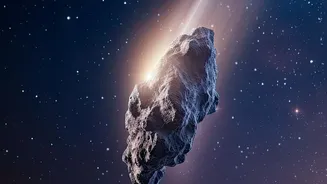
For a long time, astronomers debated the origin of the rings. Were they leftover material from when Saturn first formed 4.5 billion years ago, or are they a more recent addition? Data from NASA's Cassini mission, which studied Saturn from 2004 to 2017, has provided strong evidence for a more recent creation. The leading theories now suggest the rings formed from the destruction of an object that strayed too close to the planet. Saturn's immense gravity would have torn it apart in a region known as the Roche limit. This doomed object could have been a large comet, an asteroid, or, in one compelling theory, one of Saturn's own icy moons. One hypothesis, for example, suggests a moon dubbed 'Chrysalis' was destabilized by the outward migration of Saturn's largest moon, Titan, and sent on a collision course with the planet around 160 million years ago.
Younger Than the Dinosaurs
The idea that the rings are young is one of the most surprising findings from the Cassini mission. The rings are remarkably clean and bright, composed mostly of pure water ice. Scientists argue that if the rings were as old as the planet itself, they would be much 'dirtier' and darker, having been polluted by a constant bombardment of rocky micrometeoroids over billions of years. Based on the mass of the rings and the rate of this cosmic dust infall, researchers have estimated their age to be somewhere between 10 million and 100 million years old. This means the rings may have formed long after the first dinosaurs appeared on Earth and are not a primordial feature of the solar system.
A Disappearing Cosmic Wonder
Just as they are a relatively new addition, the rings are not permanent. In fact, they are actively disappearing. Cassini's instruments detected a phenomenon dubbed 'ring rain', where particles from the rings are being pulled inward by Saturn's gravity and magnetic field. This material then falls into the planet's upper atmosphere. The rate of this loss is astonishing, estimated to be enough material to fill an Olympic-sized swimming pool every half an hour. At this rate, the rings have a limited lifespan. Current estimates suggest they could be completely gone within the next 100 to 300 million years.