





The Ghost of Water Past
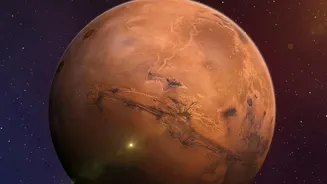
For decades, the search for water on Mars has been a central obsession for scientists and space agencies. We see the clear remnants of a wet past etched into its surface: sprawling river valleys, deltas, and vast basins that once held deep lakes. Yet,
the Mars we know today is a frigid, dusty desert. New evidence gathered by NASA's Mars Reconnaissance Orbiter (MRO) is radically reshaping this narrative. Data suggests that even after the planet's atmosphere thinned and surface water vanished, significant amounts of water may have persisted in salty, liquid form just beneath the ground. This isn't just a drop in the bucket; it’s a fundamental rethinking of Mars's history and its potential to harbor life.
A Planet's Thirsty History
To understand the significance of this finding, we have to rewind the clock about three billion years. Early Mars was a warmer, wetter world, potentially with a thick atmosphere that could support liquid water on its surface. But it didn't last. The planet underwent a dramatic climate shift, often called the "Great Martian Drying." Over time, Mars lost its magnetic field and its atmosphere was stripped away by solar wind, causing surface water to either freeze or evaporate into space. Scientists have long believed this event, which occurred during what is known as the Hesperian period, turned Mars into the desolate landscape we see today. The prevailing view was that by about 3 billion years ago, the planet's water was effectively gone, locked away as polar ice.
Following the Salt Trail
The new clues don't come from spotting water directly, but from its chemical fingerprints left behind. Using the MRO's powerful imaging spectrometer, scientists have mapped vast deposits of chloride salts across the southern highlands of Mars. Think of them like the salt rings left on a glass after water evaporates. These aren't just any salts; their location and distribution are telling. Many of these deposits are found in topographic low points and basins that aren't connected to ancient river channels. This suggests the water didn't flow in from rivers but rather welled up from underground before evaporating, leaving the chloride salts behind. This process indicates that Martian groundwater was active far more recently and extensively than previously imagined.
More Than Just a Briny Drop
The discovery of these chloride deposits rewrites the timeline for water on Mars. It suggests liquid water existed for perhaps a billion years longer than many previous estimates, extending the habitable window of the planet's past. The water that created these salt flats would have been extremely briny—far saltier than Earth's oceans. While inhospitable to humans, this very saltiness is what could have kept the water from freezing in Mars's cold climate. The existence of these widespread brines suggests a vast, interconnected system of subsurface water that survived long after the great drying event transformed the surface. This hidden hydrosphere could still exist today, locked deep within the Martian crust.
The Renewed Search for Martian Life
For astrobiologists, the mantra is simple: follow the water. While the surface of Mars is bombarded with radiation and likely sterile, the subsurface is a different story. These ancient, and possibly still-existing, underground brine reservoirs represent potential oases. Shielded from the harsh surface conditions, such environments could have provided a stable refuge for microbial life to evolve and perhaps even persist. On Earth, life thrives in extreme, salty environments, from deep-sea vents to briny pools in Antarctica. The possibility that similar "halophilic" or salt-loving organisms could have existed on Mars is now a much more concrete scientific question. These salt deposits are now prime targets for future missions aiming to find signs of past or present life.