







An Unblinking Power Source
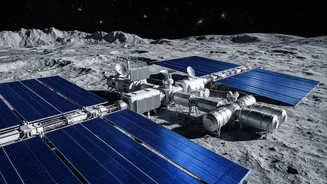
A lunar base cannot run on solar power alone. The Moon endures a roughly 14-day night, a period of extreme cold and darkness that would shut down any solar-dependent outpost. To solve this, NASA is aggressively pursuing fission surface power. In November
2026, the agency confirmed plans for 'Lunar Reactor-1', the first nuclear reactor on the Moon, targeting a 2030 landing. This builds on earlier initiatives where NASA and the U.S. Department of Energy awarded contracts to companies like Lockheed Martin and Westinghouse to develop 40-kilowatt class fission power system concepts. These compact nuclear reactors are designed to provide continuous, reliable power for a decade without refueling, a foundational requirement for keeping life support systems, rovers, and experiments running through the long lunar night. It is a critical piece of infrastructure that will enable long-term habitation and science.
The Commercial Delivery Network
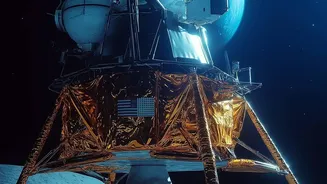
Before astronauts arrive, their supplies and equipment must be waiting for them. NASA is building a robust commercial delivery network to make this happen, modeled after the successful commercial cargo and crew programs for the International Space Station. In early November 2026, NASA announced a new phase of its Commercial Lunar Payload Services (CLPS) initiative, creating a $10 billion contract framework for which eight companies can compete to deliver cargo to the Moon. The list includes established giants and newer players like Blue Origin, SpaceX, Intuitive Machines, and Firefly Aerospace. This move essentially creates a competitive marketplace for lunar logistics, driving down costs and increasing the frequency of missions. NASA simultaneously boosted the value of its existing CLPS contracts to support more than twenty robotic landings planned through 2029, all designed to pre-deploy scientific instruments and infrastructure.
Robots Leading the Way
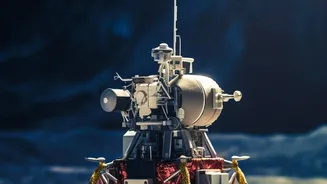
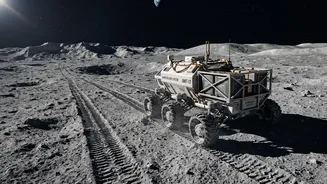
Among the first and most important deliveries will be advanced robotics. One of the flagship projects is the Polar Rover for Observation, Mapping, and In-Situ Exploration, or PROMISE. This nuclear-powered rover is slated to explore the lunar south pole starting in late 2028. NASA awarded Blue Origin a contract to deliver PROMISE to the surface using its Blue Moon Mark 1 lander. The rover will be tasked with searching for water ice and other resources essential for future sustainability. Other robotic systems are also in development. For example, Astrobotic's Griffin lander, part of the Voyager Technologies portfolio, is scheduled to deliver Astrolab's FLIP rover, which will test technologies for future 'moon buggies' that astronauts will use. These robotic missions are not just for science; they are explicitly designed to test the technologies and operational procedures needed before humans establish a permanent foothold.
Building the Artemis Foundation
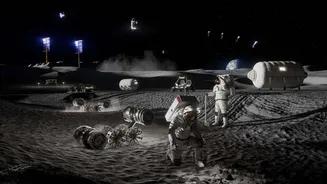
These power and delivery projects are the essential building blocks for NASA's broader Artemis program, which aims to establish a permanent, sustainable human presence on the Moon. The strategy is clear: use commercial partners and robotic systems to build out foundational infrastructure—power, logistics, and resource mapping—before committing to long-duration human missions. Recent announcements also included contracts for components of a mini-communications and solar power tower, the very first seed of a future lunar power grid. By investing in this commercial supply chain now, NASA ensures that when astronauts return to the Moon, they will arrive at a pre-established outpost with the lights on and the tools ready for work, transforming the lunar surface into a hub for science and future exploration to Mars.