






What Happened Deep Under the Pacific?
Thousands of kilometres below the Pacific Ocean, a massive river of liquid iron did something completely unexpected around the year 2010. For years, scientists observed this part of Earth's outer core flowing generally westward. But then, it abruptly
reversed course and began flowing strongly eastward. This wasn't a subtle shift; it was a dramatic change in a region previously thought to be relatively stable, leaving researchers with a fascinating new puzzle about the inner workings of our world. The discovery shows that the processes deep within Earth can be far more dynamic and faster-changing than previously believed.
How Do We See a River of Iron?
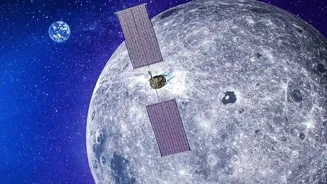
You can’t exactly send a probe 2,200 kilometres down to look at the core. Instead, scientists act like detectives, piecing together clues from above. The key is Earth's magnetic field, which is generated by the churning of this molten iron ocean in a process known as the geodynamo. A trio of specialised satellites from the European Space Agency, known as the Swarm mission, constantly measures this magnetic field with incredible precision. By analyzing tiny variations and fluctuations in the field over time, scientists can infer the speed and direction of the liquid iron flowing deep below. It was this satellite data, combined with older measurements, that revealed the startling 2010 reversal.
Why This Molten Flow Matters
While it might seem remote, the behaviour of the outer core is directly linked to our survival. The magnetic field it generates acts as a planetary shield, deflecting harmful charged particles from the sun and cosmic rays. Without this protective bubble, solar winds could strip away our atmosphere, making life on the surface impossible. Understanding the core's dynamics is therefore essential for understanding the stability of our magnetic shield. Sudden, rapid changes like the 2010 flow reversal provide a rare window into the complex physics that govern our planet’s habitability and protect everything from our power grids to our communication systems.
Is This a Sign of Something Bigger?
Whenever the core's behaviour is mentioned, questions about a full magnetic pole reversal—where north becomes south—often follow. However, this specific event is not seen as a sign of an imminent flip. Instead, scientists are focused on what it tells us about the core's general behaviour. Events like this are sometimes linked to phenomena called "geomagnetic jerks"—abrupt, regional accelerations in the magnetic field that happen every decade or so. These jerks are still not fully understood, but this core-flow reversal provides a major clue, suggesting they may be caused by powerful waves or movements of material deep within the core.
An Unfolding Scientific Mystery
The biggest question for scientists now is: what caused the reversal, and what happens next? They are uncertain whether this eastward flow was a brief, one-off event, part of a repeating natural cycle, or the beginning of a new, long-term pattern. Interestingly, the latest models suggest that the strong eastward flow has already started to weaken since 2020. This adds another layer to the mystery. Researchers will continue to monitor the magnetic field using the Swarm satellites, hoping to catch the core in the act and build a more complete picture of the turbulent, powerful, and still largely unknown world that exists deep inside our own planet.