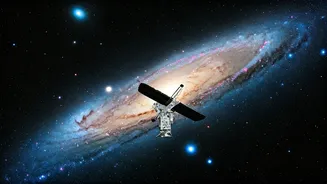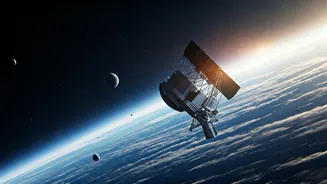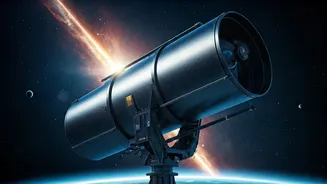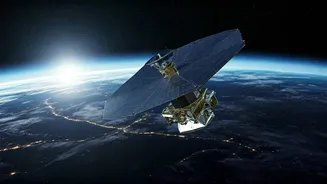




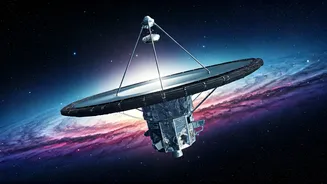
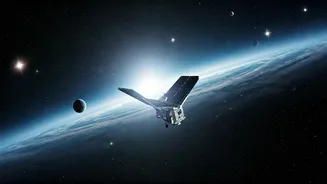


Meet the Roman Space Telescope
Formerly known as the Wide-Field Infrared Survey Telescope (WFIRST), this next-generation observatory was renamed in honor of Nancy Grace Roman, NASA’s first chief of astronomy and the “mother” of the Hubble Space Telescope. Currently preparing for a launch
as soon as late 2026, the Roman Telescope is engineered for efficiency and scale. Its primary mission is to tackle some of the biggest questions in astrophysics by imaging enormous sections of the sky. While other telescopes provide deep, narrow views, Roman will create panoramic vistas of the cosmos, providing crucial context and a wealth of data for astronomers worldwide.
A Panoramic Window on the Universe
Roman's standout feature is its immense field of view. Its Wide Field Instrument can capture an area of the sky 100 to 200 times larger than Hubble's infrared camera in a single snapshot, all while maintaining a similar, stunning image resolution. This capability will allow it to map the Milky Way and distant galaxies with unprecedented speed, collecting data thousands of times faster than Hubble could. Imagine trying to create a complete map of a forest by taking photos of one tree at a time; that’s the traditional approach. Roman, by contrast, is designed to photograph the entire mountain range at once. This broad perspective is essential for its core scientific goals: studying dark energy and discovering thousands of new exoplanets.
Chasing the Universe's Biggest Mysteries
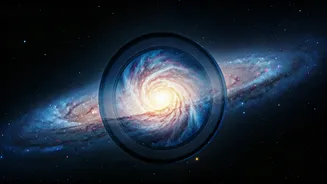
Two of the most profound puzzles in cosmology are dark energy and dark matter. Dark energy is the mysterious force causing the universe's expansion to accelerate, while dark matter is the invisible substance that provides the gravitational scaffolding for galaxies. Roman will address both head-on. By surveying billions of galaxies and observing distant stellar explosions known as supernovae, it will create a 3D map of the universe's structure and chart its expansion history. These observations will allow scientists to test theories about dark energy and measure its effects over cosmic time, potentially revealing whether this force is constant or changing.
A New Era for Exoplanet Hunting
Beyond cosmology, Roman is set to revolutionize the hunt for planets outside our solar system. While missions like Kepler and TESS have found thousands of exoplanets by looking for the dimming of starlight as a planet passes in front of its star (the transit method), Roman will primarily use a different technique called gravitational microlensing. This method detects planets by observing how their gravity, combined with their host star's, bends and magnifies the light from a more distant, unrelated star that momentarily aligns with them. This technique is sensitive enough to find planets much farther away and even free-floating 'rogue' planets that don't orbit a star. Scientists anticipate Roman will discover a staggering 100,000 new exoplanets, providing a massive statistical census of planetary systems throughout our galaxy.
A Powerful Partner, Not a Replacement
Roman is not meant to replace the James Webb Space Telescope (JWST) or Hubble, but to complement them. While Webb excels at deep, detailed observations of specific targets, Roman is the master of the wide survey. A perfect partnership would see Roman identifying tens of thousands of interesting objects—be it unusual galaxies or promising exoplanet systems—and Webb following up for in-depth analysis. Roman will cast the wide net to find the cosmic fish, and Webb will reel them in for a closer look. Together, these observatories will provide the most complete picture of our universe yet, from the grandest cosmic structures to the unique characteristics of individual alien worlds.