





The Trillion-Rupee Trash Problem Above
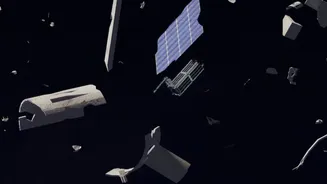
For over sixty years, humanity has been launching rockets, deploying satellites, and exploring the cosmos. Every mission has left something behind. Today, low Earth orbit (LEO) is cluttered with an estimated 36,500 objects larger than 10 cm—defunct satellites, spent
rocket stages, and fragments from collisions. Travelling at speeds of up to 28,000 kilometres per hour, even a tiny paint fleck can cause catastrophic damage to a functional satellite. The growing risk is a phenomenon known as the Kessler Syndrome, a cascading chain reaction where one collision creates more debris, leading to more collisions, potentially rendering entire orbits unusable. This puts our reliance on satellites for everything from GPS and weather forecasting to internet connectivity and national security at immense risk.
A High-Tech Cosmic Cleanup
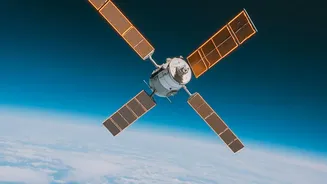
Cleaning up space is not as simple as sending up a garbage truck. A new generation of companies and space agencies are developing innovative solutions that sound like science fiction. Technologies include deploying giant nets to capture large objects, firing harpoons to snag rogue satellites, and using powerful robotic arms for 'in-orbit servicing'. Companies like Switzerland's ClearSpace and Japan's Astroscale are pioneering demonstration missions. ClearSpace is preparing to capture a piece of a European rocket with a four-armed robotic claw, while Astroscale has successfully demonstrated magnetic docking technology to handle future satellites designed for easier removal. Other concepts involve powerful lasers to nudge debris into new orbits or push it to burn up in the atmosphere.
The Twin Engines: Regulation and Commercial Need
The $9.57 billion market forecast hinges on two critical drivers. First, regulation is tightening. Agencies like the U.S. Federal Communications Commission (FCC) have slashed the time satellite operators have to deorbit their defunct spacecraft from 25 years to just 5 years. This creates a mandatory demand for end-of-life services. Second, commercial demand is soaring. The explosion of satellite mega-constellations from companies like SpaceX and OneWeb means there is more valuable hardware in orbit than ever before. These commercial operators have a vested financial interest in keeping their orbital paths clear to protect their multi-billion dollar investments from collision risks. Protecting these assets is becoming a core part of business planning.
The Legal and Technical Hurdles
Despite the momentum, significant challenges remain. A major issue is international law. Under the 1967 Outer Space Treaty, a space object, even if it's just a piece of junk, remains the property of the nation that launched it. This means one country cannot simply remove another country's debris without permission, creating a complex legal quagmire. Furthermore, the technology is still in its infancy and incredibly expensive. Active Debris Removal (ADR) missions are complex and costly, and proving a return on investment can be difficult. The success of the market will depend on creating scalable, cost-effective solutions and establishing clear international protocols for who is responsible for what and, crucially, who pays.
India’s Role in Orbital Sustainability
India, a major space-faring nation, is actively engaged in tackling the debris problem. The Indian Space Research Organisation (ISRO) has its own 'Debris Free Space Mission' (DFSM) initiative and is developing precursor technologies for active debris removal. Through Project NETRA, ISRO has enhanced its ability to track and monitor objects that could threaten Indian satellites. The country has also mandated that Indian space actors must follow international guidelines for post-mission disposal, including a 5-year orbital decay rule for certain missions. As the global market grows, there is a significant opportunity for Indian startups, several of which are already working on space sustainability solutions, to become key players in this emerging sector.