


The 'Evening Star' Takes Centre Stage
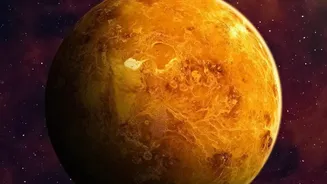
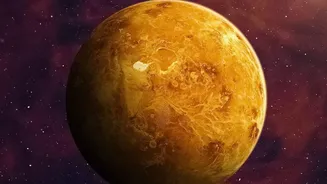
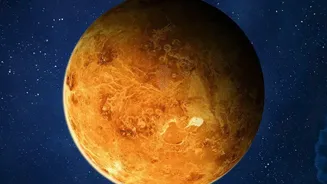
If you've noticed a dazzling point of light in the west after sunset recently, you've been watching Venus. Often called the 'Evening Star', this is no star at all, but Earth's closest planetary neighbour. On August 15, 2026, Venus will reach what astronomers
call its 'greatest eastern elongation'. In simple terms, this is the moment when Venus appears farthest from the Sun in our sky from our perspective on Earth. Because Venus's orbit is inside our own, it's always tethered to the Sun in our view, visible either just before sunrise or just after sunset. This elongation marks the peak of its evening performance, the widest gap it will achieve from the Sun's glare for this cycle, making it the best time to observe the planet in the evening.
A Paradoxical View: Far but Low
This year, the greatest elongation on August 15 presents an interesting paradox for skywatchers, especially in the Northern Hemisphere, which includes India. While Venus will be at its maximum angular separation from the Sun—about 46 degrees—it will appear surprisingly low in the western sky. This happens because of the angle of the ecliptic—the path the Sun, Moon, and planets follow across the sky—during late summer evenings. At this time of year, the ecliptic makes a shallow angle with the western horizon at sunset. So, even though Venus is far from the Sun along this path, the entire path is slanted low. This means that Venus will set not long after twilight ends, giving a shorter viewing window than some other elongations. Observers in tropical and Southern Hemisphere locations will actually get a better, higher view.
A Sky-Watcher's Guide for India
For viewers across India, the instructions are straightforward. Begin looking about 30 minutes after sunset. Find a location with a clear, unobstructed view of the western horizon, away from the worst of city light pollution if possible. Venus will be impossible to miss; it shines with a brilliant, unwavering light at a magnitude of around -4.4, far brighter than any actual star. Unlike stars, which twinkle, Venus’s light will be steady and powerful. On the evenings of August 14 and 15, your view will be enhanced by a thin waxing crescent Moon, which will be visible near the dazzling planet, creating a beautiful celestial pairing low in the twilight sky. Use this opportunity to take in the sight, as after this peak, Venus will begin to sink lower into the twilight glow each evening as it speeds towards its inferior conjunction in October.
The Science Behind the Sight
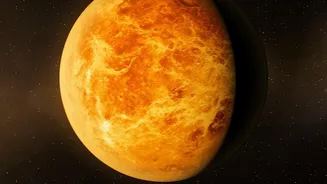
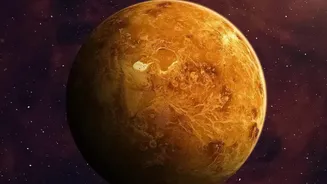
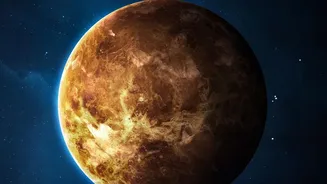
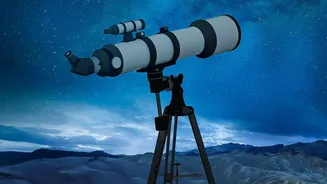
What we witness as a beautiful 'star' in the evening is a direct result of celestial mechanics. Venus circles the Sun in just 225 Earth days. As it travels along its faster, inner orbit, our viewing angle from Earth constantly changes. This creates the cycle of Venus appearing first in the morning sky, then disappearing into the Sun's glare at superior conjunction, re-emerging as the Evening Star, and then swinging between Earth and the Sun at inferior conjunction to begin the cycle again. When Venus is at greatest eastern elongation, it forms a right-angled triangle with the Earth and the Sun, with the right angle at Venus. This geometric alignment is what allows us to see it at its maximum separation from the Sun. If you were to look at Venus through a telescope on this date, you would see that it looks like a tiny, half-lit Moon, a phase known as dichotomy.