







Why Rings Change Everything
The standard dip, performed on stationary parallel bars, is a cornerstone of upper-body training for a reason. It effectively targets the triceps, chest, and shoulders. However, when you switch from solid bars to free-moving gymnastic rings, the exercise
transforms entirely. The introduction of instability is the key difference and the source of the advanced challenge. While bar dips allow you to focus purely on pushing strength, ring dips force your body to fight for balance with every centimetre of the movement. This constant battle against instability recruits a host of smaller, stabilising muscles that are often neglected in traditional weight training.
The Unique Demands of Instability
The true demand of the ring dip lies in neuromuscular control. The rings can move in any direction, meaning your shoulders, elbows, and wrists must work in perfect coordination to maintain a stable path. This requires immense engagement from the rotator cuff muscles around the shoulder joint, as well as the core and even the forearms. This heightened muscle activation is what makes the exercise so effective. It increases the time your muscles are under tension, a crucial factor for hypertrophy (muscle growth), and builds a type of functional strength that carries over to other athletic movements and can even improve shoulder health by promoting stability through a full range of motion.
Muscles Under Fire: More Than Just Triceps
While the name of the game is advanced triceps training, ring dips are a compound movement that taxes the entire upper body. The primary movers are, of course, the triceps brachii, which work to extend the elbow. Alongside them, the pectoralis major (chest) and anterior deltoids (front of the shoulders) are heavily involved in the pushing motion. However, the supporting cast is just as important. Stabilizer muscles in the scapula (shoulder blades), the lats, and the core must remain braced throughout to prevent shaking and maintain proper form. This comprehensive muscle recruitment is what makes ring dips a far superior exercise for developing a well-rounded and resilient upper body compared to more isolated movements.
Executing the Perfect Ring Dip
Proper form is non-negotiable to reap the benefits and avoid injury. Start in a 'support hold' position with your arms fully locked out and the rings turned slightly outwards. Keep the rings close to your body. Begin the descent by slowly bending your elbows, keeping them tucked in rather than flaring out. Lower yourself until your shoulders are slightly below your elbows. It's crucial to maintain an upright torso and avoid letting your shoulders roll forward, a common mistake that puts undue stress on the joint. From the bottom position, press yourself back up explosively but with control, returning to the starting support hold. Avoid using momentum or 'kipping' the movement.
Your Progression to Mastery
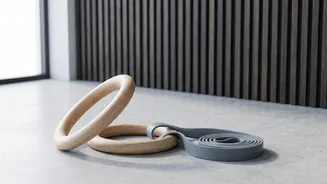
Few people can perform a perfect ring dip on their first try. It’s an advanced skill that requires a solid foundation of strength and stability. If you're not there yet, a smart progression is key. Begin by mastering the top position with static ring support holds to build stability. Once you can hold this for 30-60 seconds without excessive shaking, progress to negative ring dips, focusing only on a slow and controlled lowering phase. You can also use resistance bands for assistance, looping them under your knees or feet to reduce the load. Incorporating ring push-ups will also help build the necessary shoulder stability for the full movement.