



Meet the Cosmic Lion
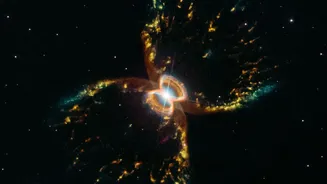
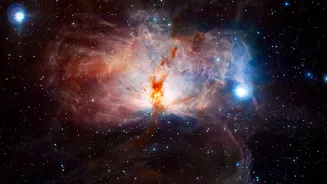
The subject of Webb’s latest masterpiece is a celestial object known as NGC 2392, a planetary nebula located thousands of light-years away. It earned the nickname “Lion Nebula” because its intricate shells of gas and dust resemble a lion's head and flowing
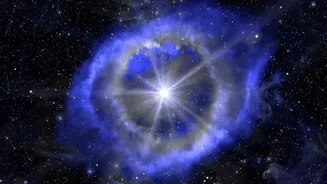
mane. Unlike the chaotic explosions of massive stars, a planetary nebula represents a more graceful, albeit dramatic, end for stars like our own Sun. As the star at the nebula's center ran out of fuel, it began shedding its outer layers into space. The hot, dense core left behind, called a white dwarf, now illuminates these expelled materials, creating the glowing spectacle we see today. It’s a snapshot of stellar death, a process that creates much of the raw material for future stars and planets. While another, more sprawling star-forming region called Sh2-132 also sometimes goes by the name Lion Nebula, it is this stunning portrait of a star's farewell that has captured the attention of astronomers.
The Power of Seeing in Infrared
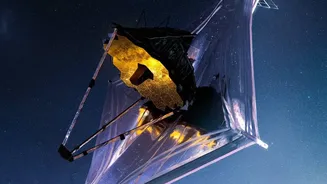
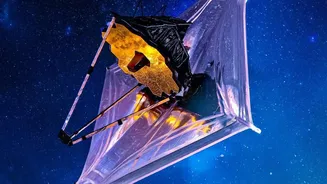
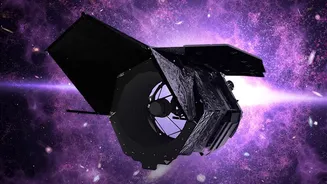
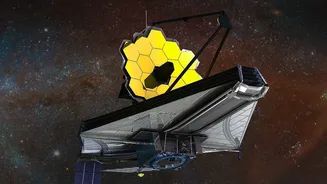
To understand why this new image is so significant, it’s crucial to understand why the James Webb Space Telescope (JWST) sees the universe in infrared light. Many cosmic objects, including the stellar nurseries and planetary nebulae, are shrouded in vast clouds of dust. This dust acts like a celestial fog, blocking shorter wavelengths of light, including the visible light our eyes can see. Telescopes like Hubble, which primarily operate in visible and ultraviolet light, can have their views obscured. Infrared light, however, has a longer wavelength that can penetrate these dusty veils. This allows Webb to peer inside structures that would otherwise be hidden, revealing the processes happening within. By focusing on infrared, JWST can capture the faint heat signatures of distant objects and uncover details about the gas, dust, and newborn stars concealed from other observatories.
A Sharper, More Detailed View
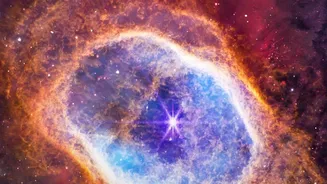
The headline's claim of a “sharper view” comes from Webb's powerful and complementary infrared instruments: the Near-Infrared Camera (NIRCam) and the Mid-Infrared Instrument (MIRI). Each captures a different slice of the infrared spectrum, and when combined, they create a composite image of staggering detail. NIRCam excels at capturing the fine, filament-like structures within the nebula's inner gas bubble—the lion’s “face.” Meanwhile, MIRI is especially sensitive to the glowing dust that makes up the outer “mane.” It reveals the texture and distribution of this material in a way previous telescopes could not. This multi-layered approach provides a more complete three-dimensional understanding of the nebula. The resulting portrait is not just sharper in terms of resolution; it's sharper in a scientific sense, distinguishing between different materials and temperatures with incredible precision.
The Science Behind the Spectacle
This new portrait is a goldmine of scientific data. At the center of the image, the white dwarf star shines like a brilliant white dot—the lion’s “nose.” Its intense radiation is blasting the surrounding space, heating the gas and causing it to glow. This process carves out the inner bubble of the nebula, which appears as cavernous shells and rings. Webb's view clearly shows how this expanding bubble is destroying some of the dust in its path. However, the image also highlights dense clumps of dust within the mane that have managed to survive this onslaught. These clumps, visible in shades of red and orange, are hardy enough to protect the material lying behind them. By studying the shape and composition of these structures, astronomers can better understand the physics of how dying stars interact with and enrich their cosmic environments.
From Data to Dazzling Image
It’s important to remember that the vibrant colors in Webb’s images are not what our eyes would see. Since infrared light is invisible to us, scientists translate this data into a visual format. They do this by assigning different colors (like red, green, and blue) to different infrared wavelengths captured by the telescope's filters. This process of creating “false-color” images is not for artistic license, but for scientific clarity. The colors help differentiate between various chemical elements, temperatures, and densities. For instance, one color might represent ionized hydrogen gas, while another highlights hydrocarbon dust. This technique turns raw, black-and-white data into a scientifically meaningful map that reveals the complex chemistry and structure of the cosmos, allowing both scientists and the public to appreciate the full story the nebula has to tell.