




The Date Was Lord Mountbatten’s Personal Choice
The decision to grant India independence on August 15, 1947, was made by the last Viceroy, Lord Louis Mountbatten. The British Parliament had given him a mandate to transfer power by June 1948, but amid escalating tensions, Mountbatten advanced the date.
He chose August 15 because it marked the second anniversary of Japan's surrender to the Allied forces in World War II, an event he considered a personal victory as he was the Supreme Allied Commander of the South East Asia Command at the time. This date was significant to his own career, and he linked it to the birth of a new, independent India.
The Indian Flag Was Adopted Just Before Independence
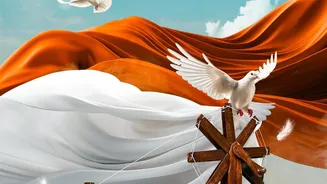
The national flag in its current form was adopted by the Constituent Assembly on July 22, 1947, only weeks before independence. The flag's design is based on the Swaraj flag created by Pingali Venkayya in 1921. The original design featured a spinning wheel (charkha) at the center. This was replaced by the Ashoka Chakra (Wheel of Law) to represent dharma and progress. The saffron, white, and green colours symbolise courage, peace, and fertility, respectively.
Our National Anthem Was Adopted Much Later
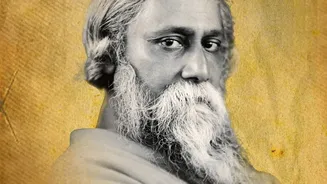
While "Jana Gana Mana" was first sung at a Congress session in 1911, it was only officially adopted as India's national anthem on January 24, 1950—nearly three years after independence. Written by Rabindranath Tagore, only the first of the five stanzas of his poem 'Bharoto Bhagyo Bidhata' became the official anthem. For a brief period after 1947, India did not have an official national anthem.
The Partition Boundary Was Drawn by a Man Who Had Never Visited India
The Radcliffe Line, which partitioned British India into India and Pakistan, was drawn by Sir Cyril Radcliffe, a British lawyer who had no prior experience with cartography or India. He was given just five weeks in the summer of 1947 to divide the provinces of Punjab and Bengal based on religious majorities. The boundary line was officially announced on August 17, 1947, two days after independence, causing immense confusion and contributing to the chaos of Partition.
Mahatma Gandhi Was Not Part of the Celebrations
While Delhi was preparing for momentous celebrations on August 15, 1947, Mahatma Gandhi, the Father of the Nation, was in Calcutta (now Kolkata). He spent the day fasting and praying, deeply pained by the communal violence that had erupted due to the Partition. He was against the division of the country and chose to spend the day trying to bring peace to the riot-torn regions of Bengal.
India Was a Dominion, Not a Republic, in 1947
When India gained independence, it did not immediately become a republic. It was established as a constitutional monarchy with King George VI as the head of state, represented by the Governor-General. This was part of the Indian Independence Act of 1947, which created two independent dominions, India and Pakistan. India officially became a republic on January 26, 1950, when its Constitution came into effect and Dr. Rajendra Prasad became the country's first President.
Over 500 Princely States Had to be Integrated
Independence was not just about freedom from the British but also about unifying the nation. At the time, there were nearly 565 princely states that were not directly part of British India. These states were given the choice to join India, Pakistan, or remain independent. It was the monumental task of Sardar Vallabhbhai Patel, India's first Deputy Prime Minister, and V.P. Menon, to persuade these rulers to accede to India, a process that took several years and a mix of diplomacy and firm action.
Goa Remained a Portuguese Colony
While most of India celebrated freedom in 1947, Goa remained under Portuguese rule. After independence, Portugal amended its constitution to declare Goa a Portuguese state rather than a colony. It was only in December 1961, after the Indian Armed Forces launched a military operation, that Goa was liberated and annexed into the Indian Union.
Other Countries Share Our Independence Day
August 15 is a significant day for several other nations as well. South Korea gained its independence from Japan on August 15, 1945. Additionally, Bahrain, the Republic of the Congo, and Liechtenstein also celebrate their national day on August 15, each for different historical reasons.
The Indian Independence Act Was Passed in July 1947
The legal framework for India's freedom was the Indian Independence Act, which was passed by the British Parliament on July 5, 1947, and received royal assent on July 18. This act formalized the Mountbatten Plan to partition British India and transfer power to the new dominions of India and Pakistan, officially ending nearly 200 years of British rule.