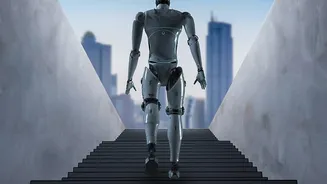




The New Economic Divide
Artificial intelligence is fundamentally reshaping labour markets, creating a stark dividing line between those who can leverage the technology and those at risk of being left behind. While some fear widespread job losses, the more immediate reality is a massive
shift in the skills employers need. Research shows that AI adoption tends to increase demand for new roles while automating specific tasks within existing ones. This can lead to a scenario where high-skilled workers who can collaborate with AI see their productivity and wages increase, while others in roles with repetitive tasks face displacement. This dynamic threatens to widen income and wealth inequality, not just between individuals but between nations, as countries with advanced AI capabilities may pull further ahead. The core issue is a growing mismatch between the skills the workforce has and the skills the AI-driven economy demands.
Beyond Coding: The Real Skills in Demand
When people hear “AI skills,” they often think of complex programming. While technical expertise is valuable, the most sought-after competencies are broader. According to the World Economic Forum and other labour market analyses, the fastest-rising skills are a blend of technical and human capabilities. These include AI and big data analysis, but also analytical and creative thinking. In India, there's a significant demand-supply gap for technical roles in AI, machine learning, and cybersecurity. However, employers are also desperate for soft skills that machines can't replicate: complex problem-solving, critical thinking, communication, resilience, and a capacity for lifelong learning. The most valuable professionals will be those who combine their domain knowledge—whether in healthcare, finance, or manufacturing—with the ability to direct and verify the output of AI tools, essentially using AI as a collaborator to multiply their effectiveness.
An Education System in Transition
Recognising this urgent need, India's education system is beginning a monumental shift. The National Education Policy (NEP) 2020 explicitly calls for integrating coding, computational thinking, and AI into the curriculum at all levels. From the 2026-27 academic year, AI and computational thinking are set to become mandatory subjects for younger students in many schools. Initiatives like the DIKSHA platform and collaborations between the CBSE, NCERT, and tech companies are aimed at developing new curricula and training materials for educators. However, a significant gap remains between policy and practice. Challenges such as India's digital divide, with inconsistent access to computers and internet in schools, and the need for massive teacher training present formidable hurdles to ensuring equitable access to this new-age education.
The Mandate for Lifelong Learning
The rapid evolution of AI means that a one-time degree is no longer sufficient for a decades-long career. The new imperative is lifelong learning. Government initiatives like the Skill India Mission and platforms such as SWAYAM and FutureSkills Prime are designed to address this, offering courses in emerging technologies for students and mid-career professionals alike. The FutureSkills Prime portal, a partnership between the government and NASSCOM, specifically targets skills in AI, cloud computing, and cybersecurity. These programs aim to make upskilling accessible to a wider population, including those in Tier-2 and Tier-3 cities, helping to bridge the gap between academic education and industry requirements. For individuals, the responsibility now lies in adopting a mindset of continuous personal development, proactively seeking out training to stay relevant in a workforce where skills are constantly changing.