


No National Anthem on Day One
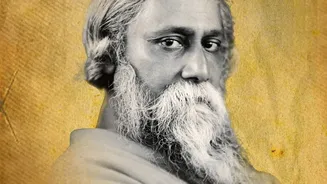
It may be surprising to learn that when India celebrated its first Independence Day on August 15, 1947, it did not have an official national anthem. While Rabindranath Tagore's 'Jana Gana Mana' was a prominent song of the freedom struggle, it was not formally
adopted. The Constituent Assembly only designated it as the national anthem on January 24, 1950, just two days before India became a republic. On the night of August 14, 1947, as the Constituent Assembly met for the first time as a sovereign body, the session concluded with a unanimous performance of 'Jana Gana Mana', but its official status was still more than two years away.
Mahatma Gandhi Was Not in Delhi
While Delhi was the epicenter of independence celebrations, the 'Father of the Nation', Mahatma Gandhi, was conspicuously absent. Deeply pained by the violence of the Partition, Gandhi was in Calcutta (now Kolkata), working to quell the communal riots that had engulfed the region. He spent August 15, 1947, at Hyderi Mansion in the Beliaghata area, fasting and holding prayer meetings to appeal for peace between Hindus and Muslims. For him, healing the societal wounds inflicted by Partition was more urgent than participating in the official ceremonies. His presence had a calming effect, a feat Lord Mountbatten later described as the work of a 'one-man army'.
The Last Viceroy Became the First Governor-General
In a unique political transition, Lord Mountbatten, the last British Viceroy of India, stayed on to become the first Governor-General of the independent Dominion of India. At the request of Prime Minister Jawaharlal Nehru, Mountbatten continued in this new role from August 15, 1947, until June 1948. During this period, he played a crucial role in persuading the rulers of many of the 500-plus princely states to accede to India, helping to stitch together the new nation. He was succeeded by C. Rajagopalachari, who became the first and only Indian Governor-General.
Not All States Joined India Immediately
The map of India on August 15, 1947, was not as we know it today. Over 500 princely states were given the choice to join India, join Pakistan, or remain independent. While most, like Bikaner and Baroda, acceded before independence, a few held out. The most prominent examples were Hyderabad, Junagadh, and Jammu and Kashmir. Hyderabad's Nizam wanted independence, Junagadh's Nawab chose to join Pakistan despite having a Hindu-majority population, and Kashmir's Maharaja initially opted for neutrality. It took diplomatic negotiations, public votes, and, in the case of Hyderabad, military action ('Operation Polo') to integrate these territories into the Indian union over the following months and year.
The Division of Assets
The Partition of India also involved the monumental and often peculiar task of dividing the assets of British India. Pakistan was allocated 17.5% of the subcontinent's assets and liabilities. This division went beyond cash reserves and military hardware, extending to office furniture, police band instruments, and even the Viceroy's horse-drawn buggy, the ownership of which was reportedly decided by a coin toss that India won. For a little over a year, the Reserve Bank of India served as the central bank for both nations, and they even shared the same currency for a transitional period. Out of a cash balance of about Rs 400 crore, Pakistan was allotted Rs 75 crore.
Goa Remained a Foreign Colony
While India celebrated its freedom from British rule in 1947, a small part of the subcontinent remained under European colonial control. Goa, along with Daman and Diu, was still a Portuguese colony. Despite India's requests for a transfer of sovereignty, Portugal refused to negotiate. It was not until December 19, 1961, fourteen years after India's independence, that Goa was integrated into the Indian union following a military action known as 'Operation Vijay'. Goa was initially administered as a union territory along with Daman and Diu, and only became India's 25th state on May 30, 1987.