





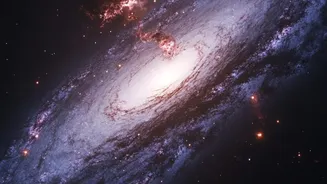
A Galaxy in Gentle Decline
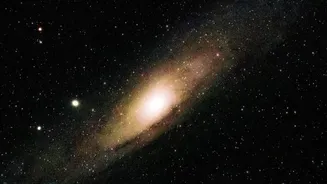
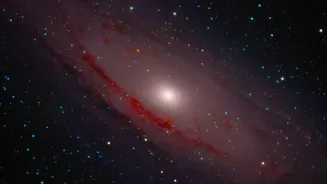
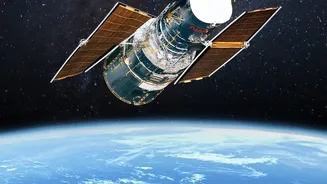
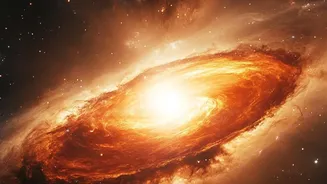
Imagine a bustling city that slowly becomes a quiet town. That's essentially what's happening 2.5 million light-years away. Astronomers using Hubble data discovered that star formation in Andromeda has been steadily decreasing for the last 500 million years.
The decline has become even more pronounced recently, with a sharp drop over the last 40 million years. To put it in numbers, 500 million years ago, Andromeda was creating stars at a rate of about one solar mass per year—similar to our own Milky Way. Today, that rate has plummeted to just one-fifth of a solar mass per year, indicating that the galaxy's most productive days are behind it.
Reading the Stellar Fossil Record
So, how can scientists look back in time? They read the stars. By creating an unprecedentedly detailed map of two-thirds of Andromeda’s disk, the Hubble surveys measured around 200 million individual stars. These stars act as a fossil record. Massive, young stars burn hot and blue but have short lives, while smaller, older stars are redder and live for billions of years. By analysing the colour and age of star populations across thousands of different regions of the galaxy, researchers could reconstruct a detailed history of when and where stars were born. This gave them a comprehensive timeline of Andromeda's star-forming activity, revealing the long, slow decline.
Why is the Fire Fading?
The primary reason for the slowdown seems to be a natural consequence of Andromeda's past. About 2 billion years ago, the galaxy experienced a massive burst of star formation, likely triggered by a merger with another, smaller galaxy. Since that intense period, the galaxy has been on a long, steady cooldown. Much of the recent decline is driven by the fading of a prominent, active star-forming ring located about 32,000 light-years from the galactic centre. As activity in this stellar nursery wanes, the galaxy's overall production rate drops with it. It’s less that Andromeda is running out of gas and more that it's taking a breather after a marathon, as one researcher described it.
A Glimpse of Our Own Future?
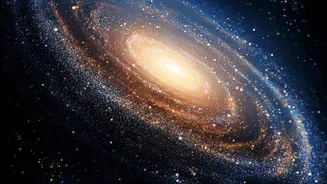
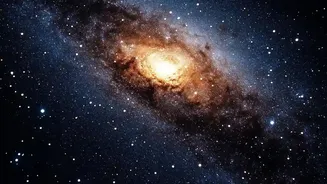
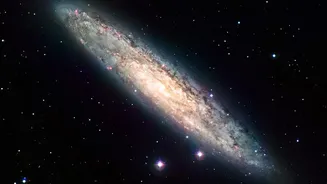
Studying Andromeda is like looking at a slightly older sibling of our own Milky Way. Because we are inside the Milky Way, it's impossible for us to get a clear, external view of our galaxy's overall structure and history. Andromeda offers the perfect laboratory: it’s close enough for Hubble to resolve individual stars, yet far enough to see its grand structure. Its story provides a powerful model for how large spiral galaxies like ours evolve. While the Milky Way is still actively forming stars, Andromeda’s slow decline is a preview of the eventual fate of most galaxies. This process of winding down is part of a universal trend; the overall rate of star birth across the cosmos has been falling for the last 10 billion years since its peak at what astronomers call 'cosmic noon'.
The Grand Finale is Still to Come
While Andromeda is quieting down now, its most dramatic moment is yet to come. It is hurtling towards our Milky Way, and the two galaxies are predicted to collide in about 4.5 billion years. This colossal merger, which will create a new galaxy nicknamed 'Milkomeda', won't be a smash-up of individual stars, which are too far apart. Instead, gravity will warp and twist the two galaxies, flinging some stars into new orbits and eventually settling into a new, larger structure, likely an elliptical galaxy. This cosmic collision is expected to trigger a spectacular, final burst of star formation, using up the remaining gas and dust from both galaxies in a brilliant farewell before settling into a much quieter, older age.