






An AI Supercomputer in a Single Rack
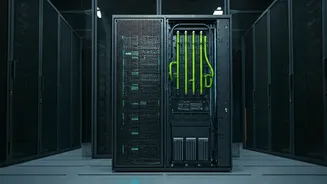
The system at the center of the attention is the GB200 NVL72. It's not just a new chip; it's a fully integrated, liquid-cooled rack that functions like a single, colossal GPU. Housing 72 of NVIDIA's next-generation Blackwell GPUs and 36 Grace CPUs, it promises
a monumental leap in performance for training and running the world's most complex artificial intelligence models. The company claims it can offer up to a 30-fold performance increase for AI inference tasks compared to its predecessor. This level of power is designed to unlock real-time performance for trillion-parameter AI models, a task that was previously unthinkable. The entire unit weighs about 1,360 kilograms and consumes up to 120 kilowatts of power, a testament to the sheer density of its computing power. For NVIDIA, this represents a strategic shift from selling individual components to providing entire, high-margin, plug-and-play AI supercomputers to its biggest clients like Microsoft, Meta, and Google.
The Bottlenecks of Innovation
Creating a machine of this complexity is proving to be a formidable challenge. Reports indicate that the primary issues stem from the system's unprecedented power and thermal demands. Effectively cooling a rack that consumes over 100 kilowatts has pushed the limits of current technology, leading to issues with overheating and leaks in the direct liquid cooling systems. These intricate systems, designed to pipe coolant directly to the processors, are a new frontier for data centers at this scale. Further complicating matters are the advanced packaging techniques used for the Blackwell chips themselves. NVIDIA is using a technology called CoWoS-L, which involves linking multiple smaller chiplets together. Mismatches in how different materials expand with heat have reportedly caused structural warping, requiring design revisions. These engineering hurdles, from power delivery to board complexity and inter-chip connectivity, have slowed the ramp-up to high-volume production, even though initial shipments have begun.
The Ripple Effect on the AI Industry
A delay in the mass availability of the GB200 NVL72 isn't just an internal problem for NVIDIA; it has significant ripple effects across the entire tech industry. The world's largest cloud providers and AI companies have built their future roadmaps around the deployment of these next-generation systems. Delays can postpone the launch of new AI services and features that depend on this advanced hardware. Analysts have noted that the repeated delays could impact market confidence more than the shipment numbers themselves. While some partners like Dell have confirmed that systems are shipping, the pace of the rollout is critical. The production challenges have reportedly caused some of NVIDIA's top customers to reduce initial orders or wait for revised versions of the racks. This situation potentially creates a small window of opportunity for competitors, though NVIDIA's performance lead remains substantial. To bridge the gap, the company is reportedly extending the lifespan of its previous-generation 'Hopper' architecture to satisfy immediate demand.
A High-Stakes Test of Strategy
The production issues highlight the immense risks associated with NVIDIA's aggressive, year-on-year product cadence and its strategic pivot to selling complete systems. While this move allows NVIDIA to capture more value and exert greater control over the AI hardware stack, it also makes the company responsible for solving immense system-level integration challenges that were previously handled by its partners. The entire supply chain, from chip fabrication at TSMC to memory from SK Hynix and final assembly by Foxconn, is being stretched. The complexity is immense, with a single rack requiring components from dozens of suppliers. Any hiccup in one area, be it advanced packaging, cooling components, or power delivery, can slow the entire process. Successfully navigating these bottlenecks is crucial for NVIDIA to maintain its rapid growth trajectory and satisfy the voracious, AI-driven demand from its customers.