


A Galactic Neighbor's Gentle Decline
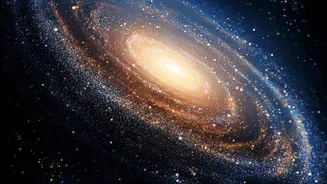
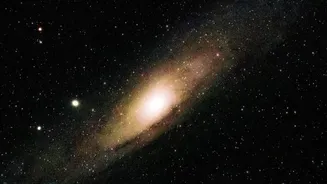
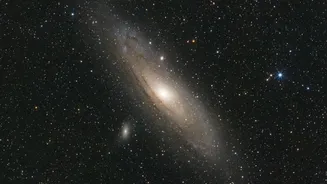
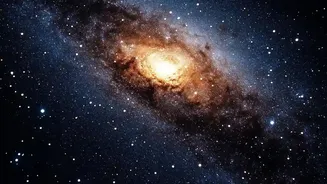
At 2.5 million light-years away, the Andromeda galaxy (M31) is the closest major spiral galaxy to our own Milky Way and a stunning sight in the night sky. Because of its proximity, it provides a unique laboratory for understanding how large galaxies like
ours live and evolve. For some time, scientists have known that Andromeda is not as vibrant as it once was. Following a major burst of star creation roughly 2 billion years ago, likely caused by a galactic merger, its pace of producing new stars has been steadily falling. A new, comprehensive study using Hubble data has now charted this decline in unprecedented detail, showing a steady slowdown over the last 500 million years, with an even sharper drop in the most recent 40 million years.
Hubble's Fossil Record of the Stars
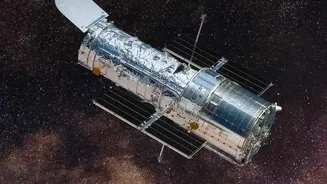
To piece this history together, astronomers conducted a massive celestial census. They combined data from two huge Hubble surveys that mapped about two-thirds of Andromeda's sprawling disk. By measuring the light from 200 million individual stars, they created a 'fossil record' of the galaxy's past activity. The technique relies on a simple principle: massive, young stars burn brightly and appear blue, but they die quickly. Older, less massive stars have a redder hue and live much longer. By analyzing the color and brightness of stars in thousands of different regions across the galaxy, the team could reconstruct when and where stars formed over millions of years. It was like reading the growth rings of a cosmic tree.
The Fading of a Great Star-Forming Ring
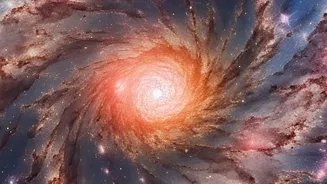
The study revealed that the slowdown wasn't happening uniformly across the galaxy. Instead, the primary culprit is the fading of a colossal ring of gas and dust located about 32,000 light-years from Andromeda's core. This ring was once the galaxy's most productive stellar nursery, responsible for the majority of its recent star birth. As the activity in this hyperactive ring has waned, it has dragged down the entire galaxy's average rate of star formation. Five hundred million years ago, Andromeda was creating stars at a rate of about one solar mass per year, similar to the Milky Way's current rate. Today, that has plummeted to just one-fifth of a solar mass per year. The galaxy isn't running out of gas; rather, it appears to be naturally entering a quieter phase after its earlier, more energetic life, much like an athlete catching their breath after a marathon.
A Case of a Troublesome Neighbor?
While the fading ring explains the broad trend, the study also uncovered localized anomalies. In one area, the decline in star formation started about 60 million years ago, a pattern that hinted at outside interference. The prime suspect is M32, a small, compact satellite galaxy orbiting Andromeda. Astronomers theorize that M32 may have punched through Andromeda's disk in the past, disrupting the gas and suppressing star formation in that region. While researchers caution they cannot definitively blame M32 yet, its proximity makes it the most likely cause for the localized dip in stellar production. The timing of the slowdown provides a crucial clue for future models trying to reconstruct the orbital dance between the two galaxies.
A Glimpse into Our Own Cosmic Future
Understanding Andromeda's evolution is more than just an academic exercise; it's a preview of what might be in store for our own Milky Way. The detailed history provided by Hubble shows that a galaxy's star-forming life is not a simple story but one of bursts, rings, and slow, inevitable declines. This research also challenges older methods of calculating star formation rates, proving that the history of star birth is more complex than previously assumed. Andromeda's quiet future is a reminder that all galaxies age. Eventually, in about 4.5 billion years, Andromeda and the Milky Way are destined to collide and merge, triggering a massive new wave of star formation before settling into a new, larger, and ultimately quieter existence.